Summary
Editor's rating
Value for money: better than renting if you drill often
Design: compact, comfortable, with a couple of trade-offs
Battery life and real-world runtime
Comfort and vibration: easier on the hands than you’d expect
Build quality and how tough it feels
Performance in concrete and brick: way better than a regular hammer drill
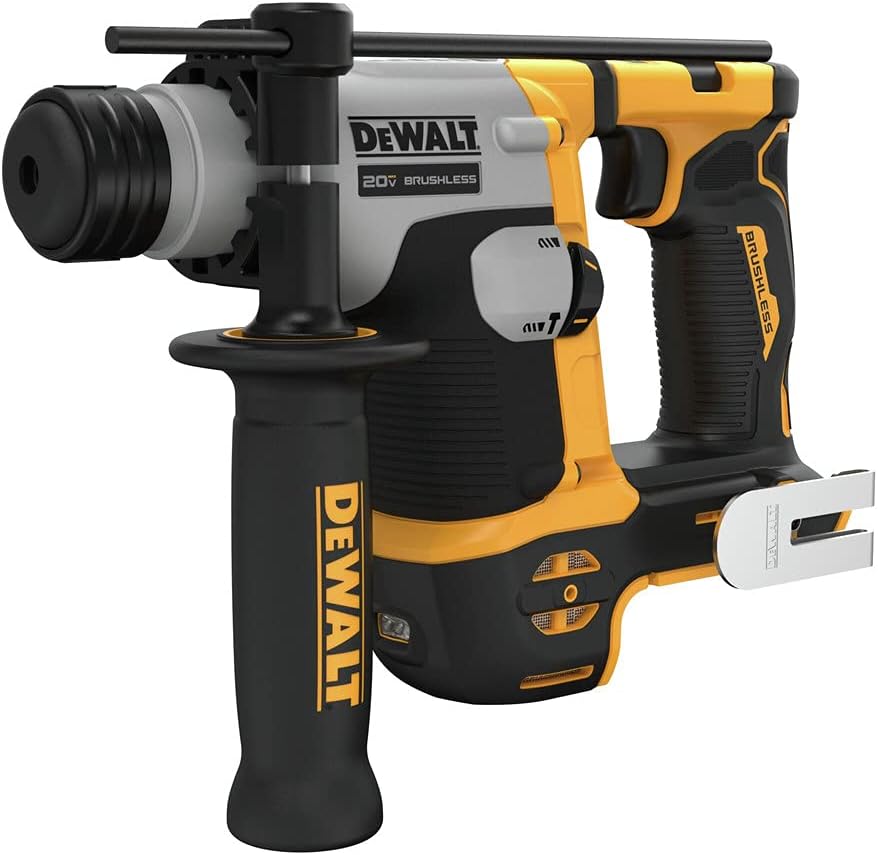
What you actually get with the DCH172B
Pros
- Compact and lightweight, much easier to use overhead or in tight spots than a full-size SDS
- Clearly faster and smoother than a regular hammer drill for typical anchor sizes in concrete and brick
- Good vibration control and comfort, so hands and arms don’t feel wrecked after a session
Cons
- Tool-only and DEWALT 20V batteries add to the total cost if you’re not already on the platform
- No hammer-only mode and not ideal for heavier chipping or large-diameter holes

Specifications
View full product page →| Brand | DEWALT |
Small rotary hammer that actually makes sense for real jobs
I’ve been using the DEWALT 20V MAX SDS Plus Rotary Hammer (DCH172B, the little 5/8" one) for a few weeks on real jobs, not just drilling a couple holes in a test board. I used it on a basement remodel, some outdoor railing anchors, and a few random “hey while you’re here” tasks. I already own a regular 20V hammer drill and a big corded SDS, so I wasn’t exactly hunting for another drill. I mainly wanted something small and cordless for overhead work and tight spots.
In practice, this thing sits right between a normal hammer drill and a full-size SDS rotary hammer. It’s way stronger and smoother than a standard hammer drill when you’re in concrete or brick, but it’s not a demolition tool. If you’re expecting it to chew through 1" holes in cured concrete all day, you’re going to be disappointed. For 3/8" and 1/2" anchors, Tapcons, and light duty chipping with a small bit, it’s in its comfort zone.
What surprised me most is how often I actually grab it. I figured it would be a “once in a while” tool, but for anything involving masonry anchors, it has basically replaced my regular hammer drill. Less vibration, faster holes, and I don’t have to lean on it as hard. It just feels more controlled. The 1.4 joules number on paper doesn’t sound like much, but for the typical homeowner or light trade work, it’s enough.
It’s not perfect though. Tool-only means you’re spending more if you don’t already have 20V MAX batteries, and it’s not the right choice if you mainly do big commercial concrete work. But if you’re already on the DEWALT platform and need a compact SDS for everyday anchors and small jobs, it actually makes a lot of sense. I’d call it a very practical upgrade over beating your wrists to death with a normal hammer drill.
Value for money: better than renting if you drill often
On price, the DCH172B sits in that middle spot: not cheap, not crazy expensive. Considering it’s tool-only, the value really depends on whether you already own DEWALT 20V MAX batteries. If you do, it’s easier to justify. If not, once you add a battery and charger, the overall bill climbs and you might pause and think about alternatives. That said, I compared it to the cost of renting an SDS from the big box stores. Around me, it’s roughly $50 for 4 hours. If you’re doing more than a couple of projects a year, buying this starts making more sense.
For a homeowner or DIY person who regularly works with concrete, brick, or block—anchoring railings, installing shelves in a masonry wall, mounting posts, that kind of thing—the value is pretty decent. It’s a big step up in ease and speed versus fighting with a basic hammer drill. You save time, and honestly you save your wrists and patience. For those kinds of tasks, it feels like money reasonably spent, not a toy or a gimmick.
If you’re a pro, value depends on your workload. For electricians, HVAC, or low-voltage guys who do a lot of small anchors and overhead work, this size is perfect and will probably pay for itself quickly in time saved and less fatigue. For heavy concrete contractors or demo crews, this is more of a second tool for light tasks, not your main rig. In that case, the value is okay but not outstanding—you’d likely pair it with a bigger rotary hammer anyway.
So overall, I’d say the value is pretty solid, especially if you’re already on the DEWALT platform and have batteries. It’s not the cheapest way to drill a couple of random holes, but if you’re doing masonry work with any regularity, owning this instead of renting or struggling with the wrong tool feels like a reasonable and practical investment.
Design: compact, comfortable, with a couple of trade-offs
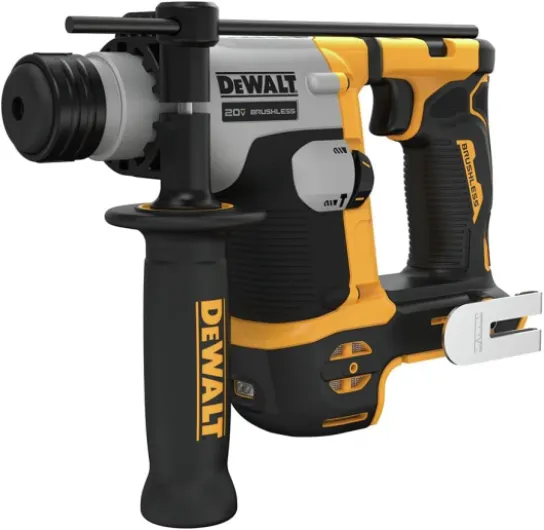
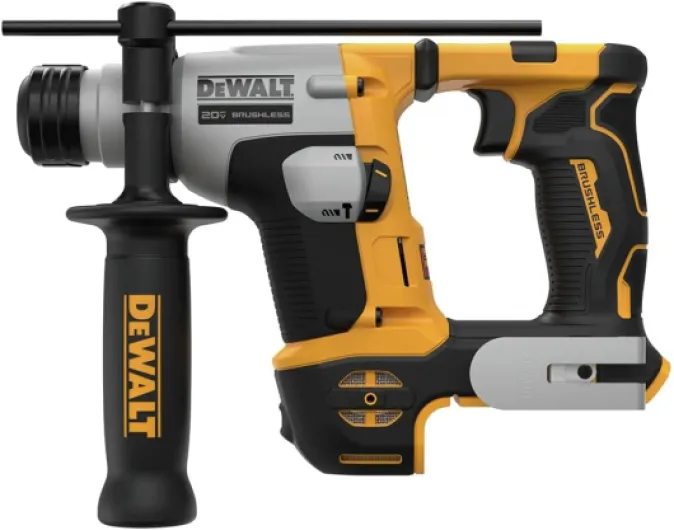
From a design standpoint, the first thing you notice is how compact and light it is. Around 4.6 lbs bare tool, and it stays pretty manageable even with a 4Ah battery on it. The overall length is short enough that working in between joists, under stairs, or in tight mechanical rooms is actually doable without constantly fighting the wall. Compared to my regular 20V hammer drill, it’s a bit bulkier at the front because of the SDS mechanism, but still very reasonable.
The grip feels typical DEWALT: rubber overmold, slightly chunky, but secure. I don’t have small hands, and it felt fine for me. I let a buddy with smaller hands try it and he said it was okay but a touch thick for long sessions. The SHOCKS vibration control is not a gimmick; you can feel a clear difference versus a cheap rotary hammer. After drilling a dozen 3/8" holes overhead in concrete, my hands weren’t buzzing like they normally would. You still feel some vibration of course, but it’s toned down enough that you don’t think about it.
The side handle is adjustable and does its job, though it’s pretty standard plastic and doesn’t feel premium. It holds position, but you can tell it’s not built for getting slammed around on big demo jobs. Controls are simple: trigger, forward/reverse selector, mode switch on the side. The mode selector is easy enough to flip with one hand, but you do need to be deliberate so you don’t stop in between positions. I didn’t have it slip out of mode on me, so no complaints there.
On the downside: there’s no built-in work light, which I actually missed when drilling in darker basements and crawl spaces. I’m used to that little LED from my regular drill. Also, the compact size is a double-edged sword: it’s great for access and weight, but it also reminds you this is not a heavy-duty SDS meant to be abused on large structural concrete all day. Design-wise, though, for the intended use (anchors, small holes, overhead work), they got most things right.
Battery life and real-world runtime
This is a tool-only unit, so how it feels depends a lot on what batteries you already own. I ran it mostly on 4Ah and 5Ah 20V MAX packs that I use on other DEWALT tools. With a 4Ah battery, I drilled roughly 40–50 holes in concrete (mix of 1/4" and 3/8") before the battery hit one bar and I swapped it out. That was in cool weather, so in hot or very cold temps your mileage may vary, but it gives an idea. For a typical day of random anchor work for a homeowner or light trade guy, one 4Ah battery is usually enough, maybe two if you’re going heavy.
On smaller 2Ah compact batteries, it’s more of a short-task setup. I tried a 2Ah pack just to see, and it’s definitely lighter and more comfortable overhead, but you notice the battery dipping quicker if you’re doing continuous drilling. For a handful of Tapcon holes or a quick job on a ladder, it’s fine. For a couple hours of solid work, I’d stick with 4Ah or bigger. The tool itself doesn’t feel underpowered on the smaller packs; you just run out of juice faster.
There’s no battery gauge on the tool itself obviously; that’s all on the batteries. It doesn’t seem to overheat or shut down on normal use. I drilled about 25 holes back-to-back in a slab and the motor housing got warm but not alarming. It didn’t cut out or complain. If you were hammering away nonstop in thick concrete on a hot day, I could see it needing a break, but again, that’s not really its use case.
One thing to keep in mind: if you’re starting from zero in the DEWALT ecosystem, the total cost jumps once you add batteries and a charger. This matters if you’re comparing it to renting a corded SDS from a big box store. But if you already have a couple of decent 20V MAX batteries lying around, the battery situation is pretty straightforward and the runtime is decent for what the tool is meant to do.
Comfort and vibration: easier on the hands than you’d expect
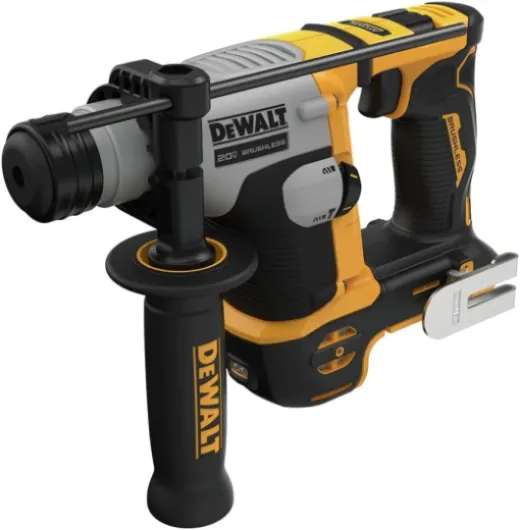
Comfort-wise, this is where I actually appreciated the tool the most. Drilling into concrete is never “pleasant”, but this thing is noticeably easier on the hands and arms than using a regular hammer drill for the same work. The SHOCKS vibration control system does help. You still feel impact, obviously, but it’s more of a controlled thud than the high-frequency buzz you get from cheaper drills. After a session of overhead drilling for a suspended ceiling, I didn’t have that numb hand feeling I usually get.
The weight balance is decent, especially with a mid-size battery. With a 5Ah pack it starts to feel a bit tail-heavy, but nothing crazy. Working overhead or on a ladder, the compact length is a big plus. You can get the bit lined up without contorting your wrist. The main handle is chunky but grippy, and the trigger is smooth enough that you can feather the speed if needed. The side handle gives you better control, though I wish the texture had a bit more bite when your gloves get dusty.
Noise level is what you’d expect from a rotary hammer: it’s not quiet, but it’s not unbearable. Ear protection still makes sense, especially indoors. I used it in a basement and in a small mechanical room, and the sound bounced around, but it wasn’t worse than other tools in this category. There’s no weird rattling or harsh mechanical clank; it feels fairly tight and controlled when running.
The main comfort downside for me is the lack of a work light and the slightly thick grip for smaller hands. In dim corners, I was grabbing a headlamp or another light, which is slightly annoying when you’re used to drills with built-in LEDs. If you have smaller hands, long sessions might get tiring faster. But as a whole, for the type of work it’s meant for, I found it comfortable enough that I actually reach for it instead of dreading the job.
Build quality and how tough it feels
I obviously haven’t owned it for years, but after a few weeks of pretty rough use, it still feels solid. The tool has that typical DEWALT feel: mostly plastic housing with rubber in the right spots, and a more serious-looking German-engineered mechanism inside doing the impact work. I’ve tossed it in the back of the van, set it down on concrete, and it’s taken a couple of small knocks without any drama. No cracks, no loose parts, and the chuck still locks bits in tight with no wiggle.
The SDS Plus chuck itself feels decent. Bits slide in and lock with a clear click, and I haven’t had any bits slip out or spin in the chuck. That’s one of the main failure points on cheaper SDS tools, so it’s good that this one feels dialed in. The mode selector still clicks positively after a bunch of switches, and the trigger hasn’t gone mushy. The belt hook is a nice extra, though I don’t fully trust hanging a rotary hammer off my pants all the time. On a framing belt or pocket, it’s handy for short moves.
One thing I will say: this is not built like a full-size, heavy-duty SDS that you’d use for big demo or industrial work. The lighter weight and more compact housing mean you probably don’t want to drop it off a scaffold or use it as a pry bar. If you respect it and use it for anchors, Tapcons, and light work, I don’t see any reason it wouldn’t last for years. The brushless motor is a plus here too: fewer wear parts, better efficiency, and usually longer life compared to brushed motors.
If you’re the type who abuses tools daily on big commercial sites, you might eventually want something bigger and more overbuilt for your main rotary hammer. But for a contractor doing mixed work, or a serious DIYer, the durability seems more than enough. I haven’t babied it, and nothing so far suggests it’s fragile. It feels like typical mid-to-upper DEWALT quality: not bulletproof, but pretty solid for normal jobsite abuse.
Performance in concrete and brick: way better than a regular hammer drill
Performance is where this tool actually earns its place. I used it on three main jobs: drilling into old brick for porch support brackets, drilling 3/8" and 1/2" holes in poured concrete for wedge anchors, and a bunch of smaller Tapcon holes in a basement wall. With proper SDS Plus masonry bits, it cuts through brick and concrete fast for its size. Compared to my standard 20V hammer drill with masonry bits, the difference is obvious: less pressure needed, cleaner holes, and much faster progress.
For example, on an old brick foundation, I drilled about 20 holes for heavy brackets. With my normal hammer drill, that would usually mean leaning hard on the tool and taking breaks because your hands are buzzing. With the DCH172B, I was basically just guiding it. Each 3/8" hole took a few seconds, dust blew out clean, and I didn’t feel like I was fighting the material. Same story in concrete: 1/4" and 3/8" holes for Tapcons went quickly, and I didn’t have to baby the tool.
Now, there are limits. Once you start pushing towards the upper end of its rated capacity (5/8" in concrete), you feel it slow down, and it’s clear this is not supposed to be your only rotary hammer on a big commercial job. I drilled a few 1/2" holes in cured concrete and it handled them, but it took a bit more time and the motor note changed enough that I wouldn’t want to do that nonstop all day. For smaller-diameter holes, though, it’s right in the sweet spot and feels efficient.
The lack of a hammer-only mode also caps its performance in chipping tasks. I tried a small chisel bit to knock off some tile adhesive and it worked in a “get by” way, but if you do that type of work often, this isn’t the right tool. Overall, for drilling anchors and general light masonry work, I’d rate the performance pretty solid. It’s not a monster, but it’s clearly better than beating on concrete with a basic hammer drill all afternoon.
What you actually get with the DCH172B
This specific model, DCH172B, is the tool-only version. So in the box you get the rotary hammer itself, a 360° side handle, a depth rod, and a belt hook. No battery, no charger, no case. If you’re already running DEWALT 20V MAX stuff, that’s fine. If not, factor in at least one 4Ah battery and a charger, otherwise this purchase is half a tool. The drill takes SDS Plus bits only, so your regular smooth or hex shank masonry bits won’t fit. You’ll need proper SDS bits.
Specs-wise, it runs on 20V MAX, does up to 1100 RPM, and DEWALT rates it at 1.4 joules of impact energy. In plain terms, it’s made for small to medium holes in concrete and masonry, not giant core drilling. DEWALT lists it for things like rod hanging, concrete forming, cable tray and strut mounting, which is pretty accurate. The max drilling capacity is around 5/8" in concrete, 26mm in wood, 13mm in metal. I mostly stayed in the 3/16" to 1/2" range and it handled that without feeling strained.
There’s a mode selector that lets you pick between drill and hammer drill. Note: there is no pure hammer-only mode on this one, so if you want to use flat chisels or do heavier chipping, you’re better off with a bigger SDS model. I used a small SDS chisel bit just to scrape some tile adhesive and it “worked”, but this tool clearly isn’t meant to be a mini chipping hammer. It’s really built around drilling holes, not demolition.
Overall, the presentation is pretty straightforward: compact rotary hammer, basic accessories, and that’s it. No nonsense, no fancy case or extra add-ons. If you’re expecting a full kit, you’ll be annoyed. If you just want a lightweight SDS body to drop into your existing DEWALT lineup, it’s exactly that. For someone already in the ecosystem, it’s a clean, simple addition.
Pros
- Compact and lightweight, much easier to use overhead or in tight spots than a full-size SDS
- Clearly faster and smoother than a regular hammer drill for typical anchor sizes in concrete and brick
- Good vibration control and comfort, so hands and arms don’t feel wrecked after a session
Cons
- Tool-only and DEWALT 20V batteries add to the total cost if you’re not already on the platform
- No hammer-only mode and not ideal for heavier chipping or large-diameter holes
Conclusion
Editor's rating
After putting the DEWALT DCH172B through real jobs, my take is simple: it’s a very practical compact rotary hammer that fills the gap between a basic hammer drill and a big SDS. For common tasks like Tapcons, 3/8" and 1/2" anchors in brick or concrete, and overhead work, it gets the job done faster and with less effort than a regular hammer drill. The vibration control is noticeable, the size is friendly for tight spaces, and if you already own DEWALT 20V MAX batteries, it drops into your setup without any fuss.
It’s not perfect. No hammer-only mode, no work light, and it’s not meant for heavy demolition or constant large-diameter drilling. If you’re a concrete contractor or doing structural work all day, you’ll want something bigger as your main tool. But for trades that do a lot of small anchors (electricians, HVAC, general remodelers) and for serious DIYers who are tired of fighting masonry with the wrong drill, it’s a pretty solid choice. The price is reasonable compared to renting frequently, and the build feels good enough to last if you use it for what it’s designed for.
If you rarely drill into concrete, I’d say save your money or just rent when needed. If you’re already on DEWALT 20V and you regularly anchor into masonry, this is one of those tools that quietly becomes your go-to whenever concrete shows up. No hype, just a compact SDS that does its job well.