Summary
Editor's rating
Value: good for the money, as long as you know its limits
Design: compact and simple, but not very refined
Materials and build: heavy where it matters, rough where it doesn’t
Durability: feels sturdy, but long-term it’s still a budget tool
Performance: light-duty workhorse, not a precision machine
What you actually get with the WEN 4208T
Pros
- Compact cast-iron benchtop design with decent stability once bolted down
- 5-speed induction motor is quiet and has enough power for wood and light metal
- Good price for a real drill press with 1/2" chuck and 2" spindle travel
Cons
- Crude table height and tilt adjustments; not very precise or repeatable
- Small work table and limited 2" spindle travel can be restrictive for larger projects

Specifications
View full product page →| Brand | WEN |
Small drill press, small price, decent power
I picked up the WEN 4208T 8-Inch drill press because I was tired of trying to drill straight holes with a handheld drill on a wobbly workbench. I don’t have a full shop or space for a floor-standing press, so I wanted something compact, cheap, and not junk. This WEN kept popping up with good reviews and was right around the 100‑buck range, so I gave it a shot.
Out of the box, it’s pretty clear this isn’t a pro industrial machine, but it also doesn’t feel like a toy. The cast iron base and head give it some real weight, and once it’s bolted down it feels pretty solid. I’ve used it for basic woodworking, some aluminum pieces, and a bit of mild steel, so I’ve had enough time with it to see what it does well and where it’s kind of annoying.
In daily use, it’s basically a straightforward, no-frills drill press. No laser, no light, no fancy digital readouts. You set the belt speed manually, clamp your work, set the depth stop if needed, and go. If you’re expecting machine-shop precision, you’ll be disappointed. If you just need straight, repeatable holes for hobby projects, jigs, or small metal brackets, it actually does a decent job.
Overall, after using it on and off over a few weeks, I’d say it’s a good fit for someone who wants a basic bench drill press without spending a fortune or taking up half the garage. It has limits—especially on precision and adjustability—but as a starter or light-duty shop tool, it’s pretty solid for the price.
Value: good for the money, as long as you know its limits
From a value standpoint, the WEN 4208T hits a nice sweet spot for a home shop. For around a hundred bucks (give or take depending on sales), you get a real cast-iron drill press that can handle wood and light metal work without feeling like a toy. If you compare that to the price of a decent handheld drill, it’s not a huge stretch, and the jump in drilling accuracy is obvious the first time you use it.
Where the value comes from is the balance of cost and capability. You get a 5‑speed induction motor, 1/2" chuck, 2" spindle travel, and an adjustable table in a compact footprint. It’s not packed with extras—no light, no laser, no crank for the table—but those are things you can live without or work around. The main job of a drill press is to drill straight holes at controlled depths, and this does that well enough for hobby use.
Compared to higher-end benchtop presses from brands like Jet or Delta, you’re giving up nicer fit and finish, smoother adjustments, better angle scales, and often more power and travel. But you’re also paying a fraction of the price. On the other side, compared to tiny “mini” presses or battery-powered stands, the WEN feels much more like a real tool. It has enough mass and power that you’re not constantly fighting flex and stall-outs.
So, is it the best deal ever? No. There are better presses if you’re willing to spend more. But for someone setting up a small shop, working in a garage, or just wanting a reliable drill press for occasional projects, it’s good value for money. If you expect pro-level precision from a sub‑$150 machine, you’ll be annoyed. If you expect a straightforward, capable drill press that gets the job done for hobby work, it’s a solid buy.
Design: compact and simple, but not very refined
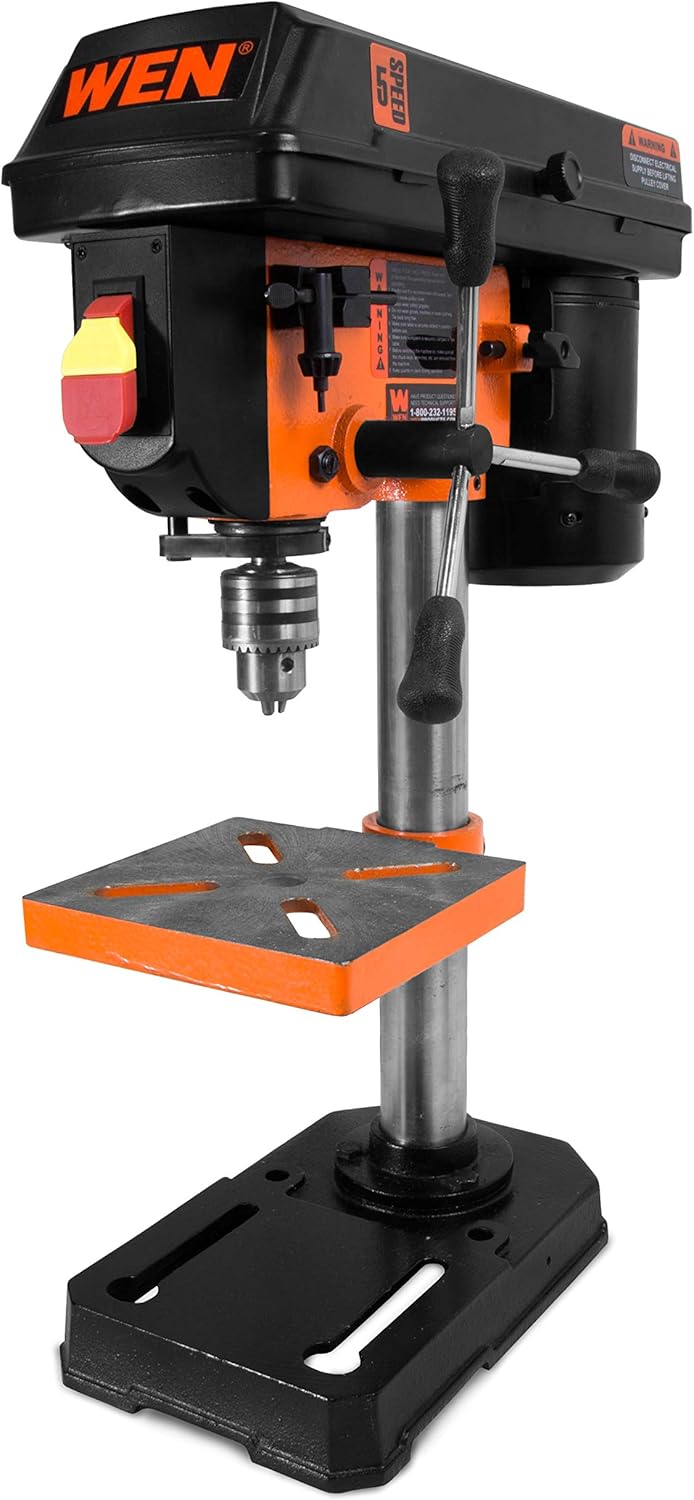
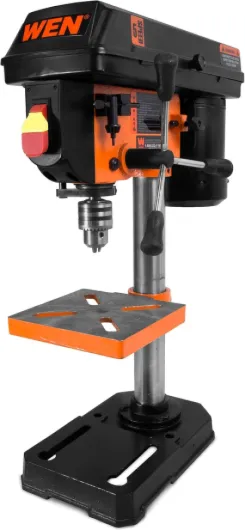
The overall design is pretty straightforward: cast iron base, steel column, cast head, and a small square table. It’s a classic benchtop drill press layout, just shrunk down. At about 34 pounds, it’s heavy enough to feel stable, but still light enough that one person can move it around if needed. Once you bolt it to a bench through the pre-drilled holes in the base, it feels much more secure and doesn’t walk around during use.
The 6.5 x 6.5 inch table is on the small side. For little parts and narrow boards it’s fine, but once you start drilling larger panels or longer pieces, you quickly feel the need for extra support or a sled. The table slides up and down the column with a simple clamp collar—no rack-and-pinion crank system—so you loosen it, manhandle it to roughly the right height, and tighten again. It works, but it’s not precise and can be a little annoying when you’re moving it often.
You can tilt the table 45° left or right using a bolt underneath, and there’s a small angle scale stamped in. Honestly, that scale is more of a rough guide than anything accurate. If you actually care about the angle, you’ll want to use a square or an angle gauge to set it. The three feed handles are on the short side, which limits how much leverage you can put on the quill. For most light work that’s fine, but you do feel it when drilling thicker hardwoods or metal; you just have to be patient and let the bit do the cutting.
One thing I liked is that the head and motor are compact and don’t stick out a mile behind the column, so it doesn’t hog too much bench depth. On the downside, there’s no built-in work light or laser crosshair. I don’t care much about the laser, but a simple light would have been useful. The design is basically: bare essentials, no frills, good enough for basic shop work but not tuned for convenience or precision adjustments.
Materials and build: heavy where it matters, rough where it doesn’t
Material-wise, WEN did the usual budget-tool thing: they spent the money on the parts that take the stress and cut corners on the nice-to-have touches. The base and head are cast iron, which gives the press a solid feel. The column is a decent steel tube with a smooth enough surface for the table collar to slide on. The table itself is also cast metal and feels sturdy, not flimsy sheet metal. When you tighten things down, nothing feels like it’s going to bend or flex easily under normal use.
The 2.3‑amp induction motor uses ball bearings, and it runs smoother than I expected at this price. There’s no loud rattling or weird grinding noises on my unit. The pulleys and belt system are basic but functional. The belt isn’t some high-end industrial thing, but for light shop use it’s fine. If you run it constantly, you might eventually need to replace the belt, but that’s pretty normal for any drill press in this range.
Where you see the cost cutting is in the finish and smaller pieces. Some of the cast edges are a bit sharp or rough, the paint isn’t perfect, and the angle scale on the table is tiny and not especially easy to read. The feed handles are thin metal with plastic knobs that feel a bit cheap, but they do their job. The table clamp collar is just a band of metal that pinches the column; it works but doesn’t feel fancy or super precise.
The chuck on mine seated well and runs reasonably true. I didn’t measure runout with a dial indicator, but visually there’s no obvious wobble. It’s a keyed chuck, and the key itself is fine, nothing special. Overall, the materials are what you’d expect for a sub‑$150 benchtop drill press: solid where it counts, budget everywhere else. As long as you’re not expecting pro-grade machining, it’s acceptable and holds up fine for casual use.
Durability: feels sturdy, but long-term it’s still a budget tool
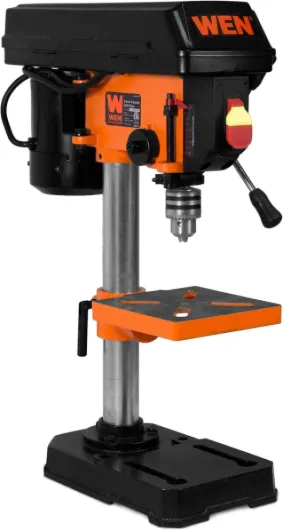
In terms of durability, I haven’t managed to break anything, and nothing has loosened up in a worrying way so far. The cast iron base and head give it a good foundation, and the column hasn’t shown any play or wobble after a bunch of weekend projects. I’ve checked the main bolts and set screws a few times, and they stayed tight with only minor re-snugging. The head is held to the column with set screws, so you don’t want to carry it around by the motor, but once it’s on the bench and tightened, it stays put.
The motor has held up fine through repeated drilling sessions. It doesn’t get excessively hot with normal use, and the belt hasn’t slipped on me unless I really lean on it in metal. That’s usually a sign I’m pushing too hard anyway. The feed mechanism and return spring still feel smooth, and there’s no grinding or binding in the quill travel. For a tool in this price range, that’s about what I’d hope for.
I don’t baby my tools, but I’m also not running a production shop. I’d say this drill press is well-suited to occasional to moderate use: weekend woodworking, hobby metalwork, and general DIY. If you’re planning to run it all day, every day, drilling heavy steel or big Forstner bits non-stop, you’re probably going to hit its limits and would be better off with a heavier, more expensive press.
Long-term, the parts that might show wear are the belt, the chuck, and maybe the table clamp if you’re constantly adjusting height. The good thing is, these are relatively easy to replace or work around. Overall, the durability feels decent for a budget benchtop press. It doesn’t feel fragile, but I also wouldn’t treat it like a $1000 industrial machine and expect it to shrug off abuse forever.
Performance: light-duty workhorse, not a precision machine
In actual use, the WEN 4208T does what I bought it for: it drills straight, repeatable holes way better than a handheld drill. I’ve run it through 3/4" oak, pine, plywood, and some 1/8" and 1/4" aluminum and mild steel. For wood, it breezes through most stuff as long as you use a decent bit and don’t try to hog out material too fast. The 2‑inch spindle travel is fine for most general tasks, but if you’re drilling deep holes in thicker stock, you’ll have to raise the table or drill in stages.
The five speeds are actually useful. For wood, I mostly use the higher speeds (2100 or 3140 RPM), and for metal I drop down to 740 or 1100 RPM. Changing speeds means opening the top cover and moving the belt, which takes maybe a minute once you get used to it. It’s not convenient if you’re constantly swapping materials, but for a hobby setup it’s acceptable. The motor doesn’t bog down easily on wood; on thicker steel, you just need to go slow, use oil, and let the bit cool a bit between passes.
Accuracy-wise, this is where you need to temper expectations. The depth stop works and lets you repeat a certain drilling depth, which is handy for things like shelf pin holes or countersinks. But the table height adjustment and tilt are not super precise. If you’re doing joinery that needs dead-on angles or a bunch of perfectly aligned holes across multiple workpieces, you’ll have to rely on good jigs and careful setups rather than the drill press adjustments themselves.
Noise level is actually pretty decent. Compared to some cheap presses I’ve used before, this one just hums. Vibration is minimal once it’s bolted down, and the quill movement feels smooth enough. In short: as a light-duty workhorse for wood and small metal jobs, it performs well for the money. As a precision machine for tight tolerances and repeatable angles, it’s not there, and you shouldn’t expect it to be at this price.
What you actually get with the WEN 4208T
The WEN 4208T is an 8‑inch, 5‑speed benchtop drill press with a 2.3‑amp induction motor. In normal language, that means it’s a small drill press that can handle light to moderate work in wood, plastic, and some metals. It stands about 23 inches tall, with a 7 x 11 inch base and a 6.5 x 6.5 inch table. The swing is 8 inches, so you can drill to the center of a piece that’s up to 8 inches wide. Spindle travel is 2 inches, so that’s your maximum straight plunge in one go.
Speed-wise, you get five belt positions: 740, 1100, 1530, 2100, and 3140 RPM. You change speeds by opening the top cover and moving the belt across the pulleys. It uses a 1/2" keyed chuck (JT33 taper), so you can run small bits up to half an inch. The motor is 110V AC, so it plugs into a normal outlet. No batteries, no nonsense.
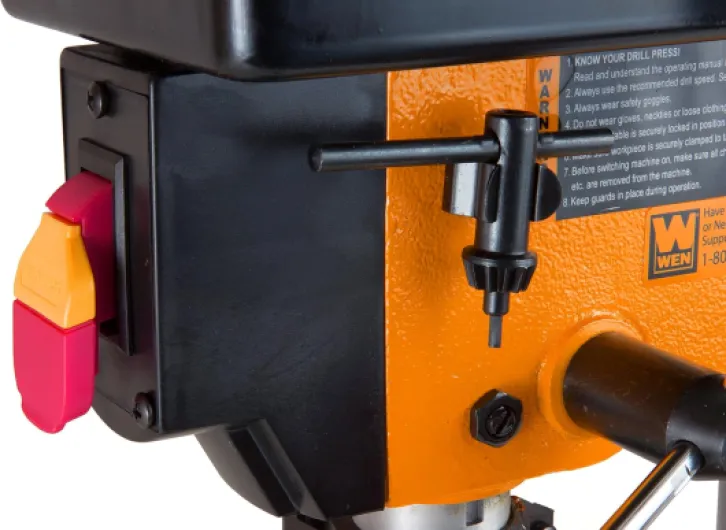
In the box, you basically get the drill press in pieces: base, column, table, head, chuck, and the three feed handles. Assembly is pretty straightforward: four bolts to mount the column to the base, slide the table on, then bolt the head to the column and install the chuck. There’s a little onboard storage spot for the chuck key, which sounds like a small thing but saves a lot of hunting around.
In terms of target use, I’d say this is aimed squarely at hobbyists, DIYers, and small home shops. It’s not built for production work or constant abuse, but if you’re drilling holes for furniture projects, jigs, brackets, knife scales, doorstops, or general tinkering, it fits that role well. It’s a simple machine that does basic drill press tasks without many extras.
Pros
- Compact cast-iron benchtop design with decent stability once bolted down
- 5-speed induction motor is quiet and has enough power for wood and light metal
- Good price for a real drill press with 1/2" chuck and 2" spindle travel
Cons
- Crude table height and tilt adjustments; not very precise or repeatable
- Small work table and limited 2" spindle travel can be restrictive for larger projects
Conclusion
Editor's rating
The WEN 4208T is basically a no-nonsense, budget benchtop drill press that does what most home DIYers and hobbyists need. It’s compact, reasonably powerful for its size, and the cast iron construction gives it a solid feel once it’s bolted down. It drills straight, it’s quiet, and the 5‑speed belt system covers the usual range for wood and light metal. You don’t get fancy features, and the adjustments (especially table height and tilt) are a bit crude, but for basic work it’s perfectly usable.
If you’re building furniture in a small garage, making jigs, drilling aluminum brackets, or just tired of crooked holes with a handheld drill, this is a good step up without blowing your budget. It’s best suited to light to moderate use where you care more about general accuracy than machine-shop precision. On the other hand, if you need dead-accurate, repeatable angles, deeper spindle travel, or a table that adjusts smoothly and precisely, you’ll probably outgrow this and should look at a larger, higher-end drill press. For the price, though, it’s a pretty solid little workhorse for an everyday home shop.