Summary
Editor's rating
Is the 2-pack and charger actually worth the price?
Chunky, yellow, and built for jobsite abuse
Real-world battery life and charging experience
Built tough, but only time will tell for long-term life
Runtime and power: big jump from the small packs
What you actually get in the box
Pros
- Two 5.0Ah batteries give a big jump in runtime over basic 2.0Ah packs
- Charger handles 12V, 20V, and 60V DEWALT batteries at a decent 4A rate
- Solid build quality with useful 3-LED fuel gauge and good tool fit
Cons
- Heavier than compact batteries, especially noticeable on smaller tools
- Price can feel high if you’re only an occasional or light user

Specifications
View full product page →| Brand | DEWALT |
Two big 20V bricks that actually last a full day
I’ve been using DEWALT 20V tools for a while, and the small 2.0Ah batteries were starting to drive me nuts. Drill a few holes, run a driver for a bit, and boom, back on the charger. So I grabbed this DCB205-2C kit with the two 5.0Ah batteries and the charger to see if it would actually change my day-to-day use, or if it was just more yellow plastic on the shelf.
To test it properly, I used these batteries on a 20V impact driver, a hammer drill, and a compact circular saw over a couple of weekends and some after-work jobs. No special treatment: concrete anchors, framing lumber cuts, some deck screws, and random DIY stuff around the house. Basically the kind of mixed use that kills weak batteries fast.
Right away, the main thing I noticed is the runtime jump compared to the basic 2.0Ah packs. With those, I’d swap batteries at least twice if I was doing anything serious. With these 5.0Ah packs, I could usually run the whole job on one battery and keep the second one as backup. For once, the tool stopped before the battery did because I was done, not because it died mid-task.
It’s not perfect – they’re heavier, and the price still stings a bit when you look at the invoice. But in practice, if you already own DEWALT 20V tools, this kit feels like moving from “annoying but workable” to “okay, this actually keeps up.” It’s basically the battery setup I wish I had bought from the start instead of limping along with the tiny packs.
Is the 2-pack and charger actually worth the price?
Price-wise, this kit isn’t cheap, but when you break it down, it’s better value than buying pieces separately. Two 5.0Ah batteries plus a multi-voltage charger usually cost more if you grab them one by one. Compared to what I see in local stores, the kit often comes in noticeably lower, especially when it’s on promo. Considering these are 5.0Ah XR packs, not the tiny starter ones, the price starts to make more sense.
For me, the value really shows up in how it changes your workflow. With the smaller packs, I was constantly pausing to charge or swapping between half-dead batteries. With this kit, I can basically treat my tools like corded ones for most jobs – just grab a battery and go, without stressing about whether I’ll run out halfway through. That alone is worth quite a bit if you value your time and hate being interrupted mid-task.
On the downside, if you’re just an occasional user who only drills a few holes every month, this might be overkill. You could live with a couple of 2.0Ah packs and a basic charger and save money. These 5.0Ah batteries really shine if you’re running tools for longer sessions – building decks, working on cars, doing renos, or using higher-draw tools like saws and blowers.
Overall, I’d call the value pretty solid if you’re already in the DEWALT 20V ecosystem and actually use your tools regularly. You pay a bit upfront, but you get longer runtime, a better charger, and less hassle. If you’re starting from scratch or upgrading from tired old batteries, this kit makes more sense than buying random single packs here and there.
Chunky, yellow, and built for jobsite abuse
Design-wise, it’s exactly what you’d expect from DEWALT: black and yellow bricks that look and feel like they’re meant to be dropped, kicked, and tossed in a toolbox. Each battery weighs about 1.4 lbs, so they’re not light, but they’re not ridiculous either. On a compact drill or impact, you definitely feel the extra weight compared to a 2.0Ah pack, but it’s still manageable for all-day use.
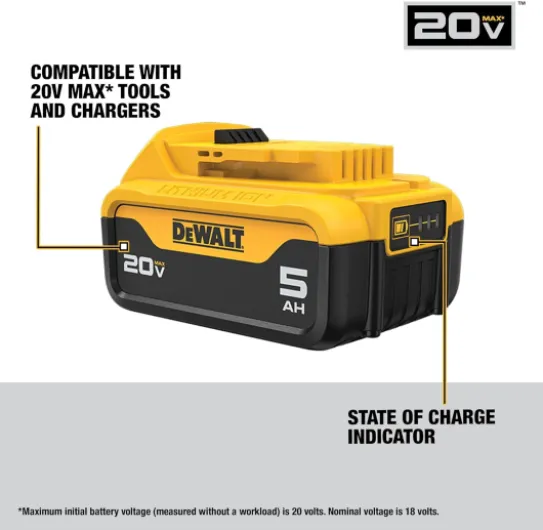
The 3-LED fuel gauge on the front is genuinely useful. I got into the habit of hitting the button before I climb a ladder or head to the backyard. One bar left? I grab the spare. It’s simple, but it saves you from climbing back down or walking back to the garage just because the battery tapped out. The LEDs are bright enough to see even outside in daylight, which is nice because some cheaper brands are hard to read in the sun.
The footprint is the standard DEWALT 20V size, so it locks into tools with a nice, solid click. No wobble on any of my tools: drill, driver, or saw. Sliding them on and off the DCB1104 charger is also smooth – no feeling like you’re going to break the rail or need two hands to pull it off. The charger itself is pretty compact, with the usual LED status light on the front telling you if it’s charging, done, or has an issue.
In practice, the design is practical and tough. Nothing fancy, but it feels like it’s made to live in the back of a truck or on a dusty bench. If you’re expecting something sleek or “high-tech looking”, this isn’t that. It’s just solid, functional gear that feels like it can handle getting knocked around without babying it, which is exactly what you want from tool batteries.
Real-world battery life and charging experience
On paper, each pack is 5.0Ah and DEWALT claims up to 60% more capacity than their standard 20V MAX battery (the DCB200). In real life, I’d say that feels about right. With the smaller packs, I’d be swapping multiple times during a medium project. With these, I typically use one battery per job, with the second one acting as a safety net that I rarely fully drain in a single session.
Here’s how it played out for me over several uses:
- Impact driver (deck screws, anchors): One 5.0Ah battery lasted through several hundred screws over a weekend without fully dying.
- Hammer drill (concrete and masonry): Drilling anchor holes in concrete, I could feel the tool working hard, but the battery still held up through multiple holes and general drilling.
- Leaf blower: This is where you really see the draw. I got around 20–30 minutes of solid use per pack, depending on how hard I ran it. Still better than swapping compact packs constantly.
The charge time is acceptable. From almost dead to full took around an hour and some change per pack on the DCB1104. Not lightning fast, but reasonable. If you’re working in a shop or at home, you can easily keep one charging while using the other. For a full-on jobsite where tools never stop, you’d probably want more packs or a multi-charger, but for most people, two 5.0Ah packs is a solid setup.
One thing I liked: when I left a battery sitting for a couple of weeks, it held its charge. I pressed the indicator button and still had the same number of bars. No obvious self-discharge issues so far. If you’re a casual user who only grabs tools on the weekend, that matters – you don’t want to find everything dead every time you start a project.
Built tough, but only time will tell for long-term life
Durability is always the big question with batteries. Out of the box, these feel sturdy and well-built. The plastic casing is thick, the rails are solid, and there’s no creaking or flex when you squeeze them. I’ve already bumped them around a bit – dropped one from about waist height onto a concrete floor by accident – and it came out with just a scuff and no performance issues.
The DEWALT reputation here lines up with my own experience. I still have older 20V DEWALT tools that are 7–8 years old, and my original smaller batteries only started to noticeably lose capacity after several years of regular use. If these 5.0Ah packs age similarly, I’d call that pretty solid. They also come with a 3-year limited warranty, which at least gives some backup if you get a dud or one fails early.
I used them in dusty conditions – drilling into concrete, cutting wood, some outdoor work – and the contacts stayed clean enough. They still slide on and off tools and the charger smoothly. No weird overheating either. After heavier use on the saw and blower, the packs got warm, but never so hot that I was worried. The charger didn’t complain or blink any error lights, and the batteries cooled down reasonably quickly once off the tool.
Obviously I can’t say after months or years yet, but based on build quality, brand track record, and early use, I’d trust these to hold up for regular DIY and light professional work. If you’re a full-time contractor beating on them every day, you’ll wear anything out eventually, but these don’t feel fragile at all. They feel like they’re meant for rough environments, not just gentle garage use.
Runtime and power: big jump from the small packs
This is where these batteries actually earn their price. Compared to the basic 2.0Ah DEWALT packs, the jump in runtime is very noticeable. On my 20V impact driver, I could run deck screws into pressure-treated lumber for a couple of hours with a 2.0Ah before it started to fade. With the 5.0Ah pack, I did almost a full afternoon of work – driving structural screws, removing old ones, and some lag bolts – and the battery still had a bar or two left.
On more power-hungry tools, like my compact 20V circular saw, the difference is even clearer. With a small battery, you can feel the saw bogging down sooner and the pack getting warm faster. With this 5.0Ah pack, I was able to rip multiple 2x4s and some plywood sheets without the saw feeling weak or the battery cutting out. It’s still a 20V saw, not a corded beast, but the extra capacity means you’re not babysitting the battery the whole time.
The charger performance is decent too. The DCB1104 took a fully drained 5.0Ah pack to full in roughly an hour or a bit more in my use, which lines up with the 4A charge rate. Practically, that means if you’re rotating between the two batteries, you can work almost non-stop: one in the tool, one on the charger. By the time you run one down, the other is usually ready or close to it, unless you’re really hammering a high-draw tool like a blower or grinder non-stop.
Overall, the power output feels consistent until the pack is nearly empty. I didn’t notice big drop-offs or the tool suddenly feeling weak long before the battery dies. For typical homeowner and light contractor work – drilling, driving, light cutting, some yard cleanup – these batteries hold up well. They’re not magic, but they finally make the 20V lineup feel like it can keep going without constant charging breaks.
What you actually get in the box
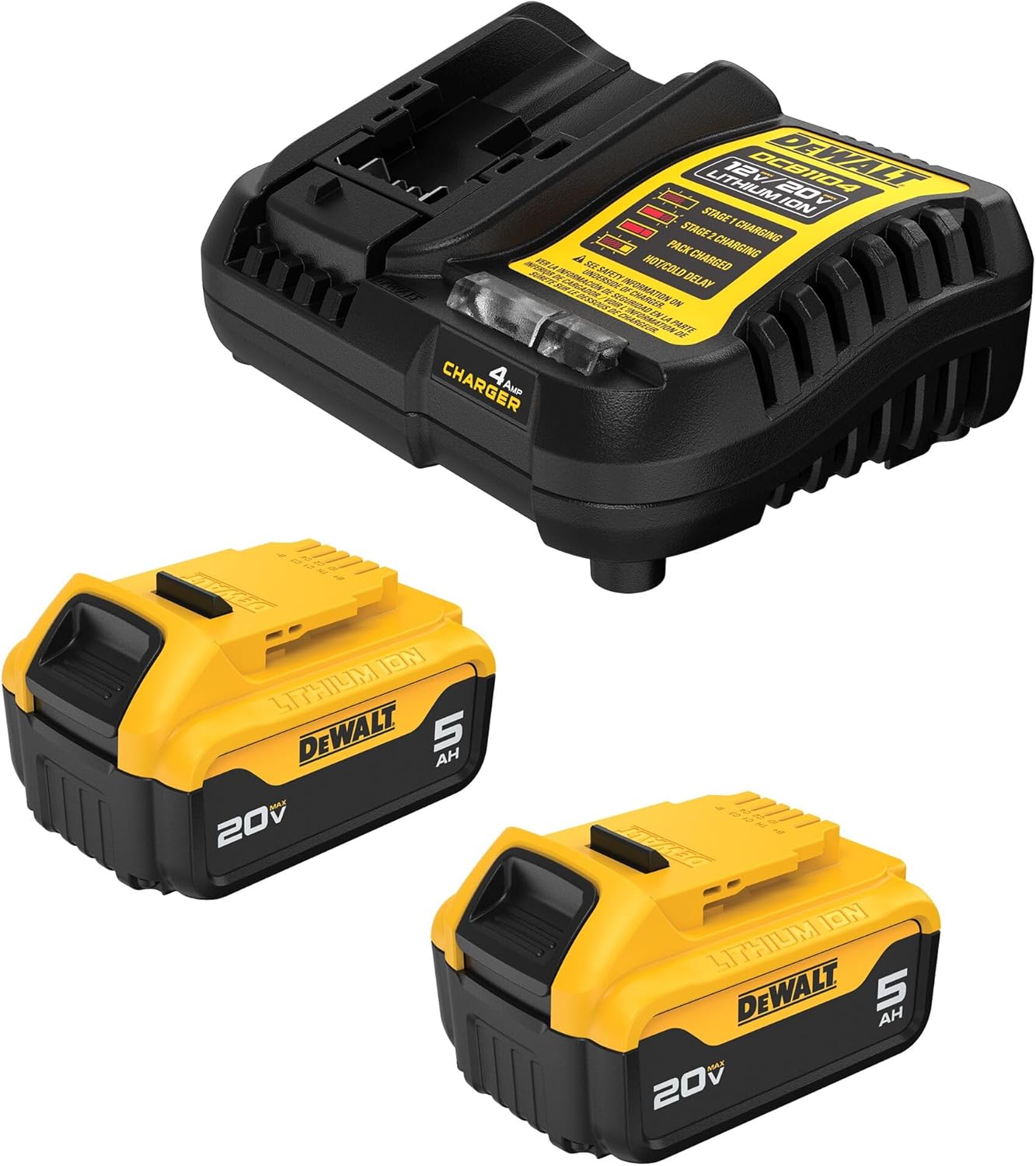
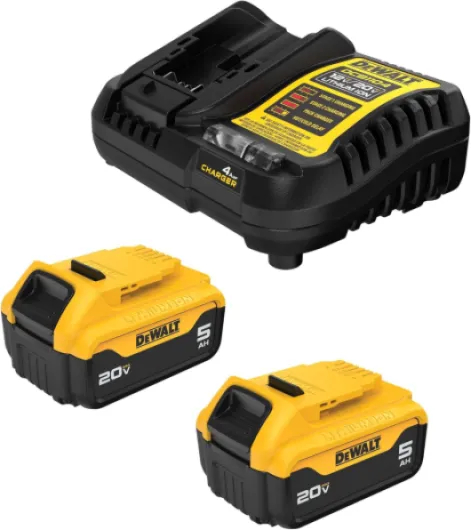
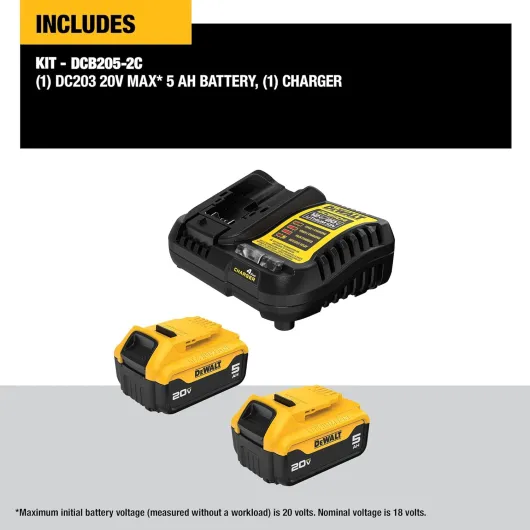
In the kit, you get two DCB205 20V MAX 5.0Ah batteries and one DCB1104 charger. That’s it. No bag, no extra accessories, just the basics. Honestly, that’s fine. I’d rather they put the money into the batteries than into some thin nylon pouch I’ll never use. The batteries come about half-charged out of the box, which is pretty standard, so you can test them right away but you’ll want to top them up before doing a real job.
The DCB205 batteries are the chunky style, not the slim compact ones. They’re rated at 5.0Ah each, so together you’re looking at 10Ah of capacity if you rotate them. The charger is one of DEWALT’s newer style units that handles 12V, 20V, and 60V packs and charges at 4 amps, which is on the faster side for this kind of stuff. It’s not the tiny travel charger; it’s a decent mid-size one you can leave on a bench or mount to a wall.
On the batteries, you’ve got the 3-LED fuel gauge button on the front. Press it and you see the charge level, which is actually useful when you’re heading out and trying to decide which packs to grab. And yes, these are fully compatible with the whole DEWALT 20V MAX line – drills, impacts, saws, lights, yard tools, all of it. I ran them on a compact impact, a full-size hammer drill, and a leaf blower with no weird behavior.
Overall, the kit is pretty straightforward: two big batteries + one decent charger. No surprises, no fancy add-ons, but it covers what you actually need – enough juice to work continuously, and a charger that doesn’t take all day. It’s the kind of bundle that makes sense if you’re starting a DEWALT setup or if your old small packs are getting tired.
Pros
- Two 5.0Ah batteries give a big jump in runtime over basic 2.0Ah packs
- Charger handles 12V, 20V, and 60V DEWALT batteries at a decent 4A rate
- Solid build quality with useful 3-LED fuel gauge and good tool fit
Cons
- Heavier than compact batteries, especially noticeable on smaller tools
- Price can feel high if you’re only an occasional or light user
Conclusion
Editor's rating
If you already own DEWALT 20V tools and you’re sick of babying small batteries, this kit does exactly what you want: it gives you real runtime and cuts down on those annoying mid-job battery swaps. The two 5.0Ah packs have enough juice to handle a full afternoon of mixed work, and the charger is quick enough that rotating between the two works fine for most people. The build feels tough, the fuel gauge is actually useful, and compatibility with 12V, 20V, and 60V DEWALT batteries makes the charger a decent long-term piece of gear.
It’s not perfect. The packs are heavier than the slim ones, and the price will sting if you’re just a casual user. If you only grab a drill a few times a year, you’re probably better off with cheaper, smaller batteries. But if you’re doing regular DIY, automotive work, or light pro jobs, the extra capacity is worth it. You spend less time waiting for batteries and more time actually using your tools.
So, who is this for? It’s great for anyone already invested in DEWALT 20V who wants longer runtime and a reliable charger, especially if your old packs are fading. Who should skip it? Very light users who barely touch their tools and people not locked into DEWALT’s system. For regular users though, it’s a solid, no-nonsense upgrade that makes your existing tools a lot more practical to use for longer stretches.