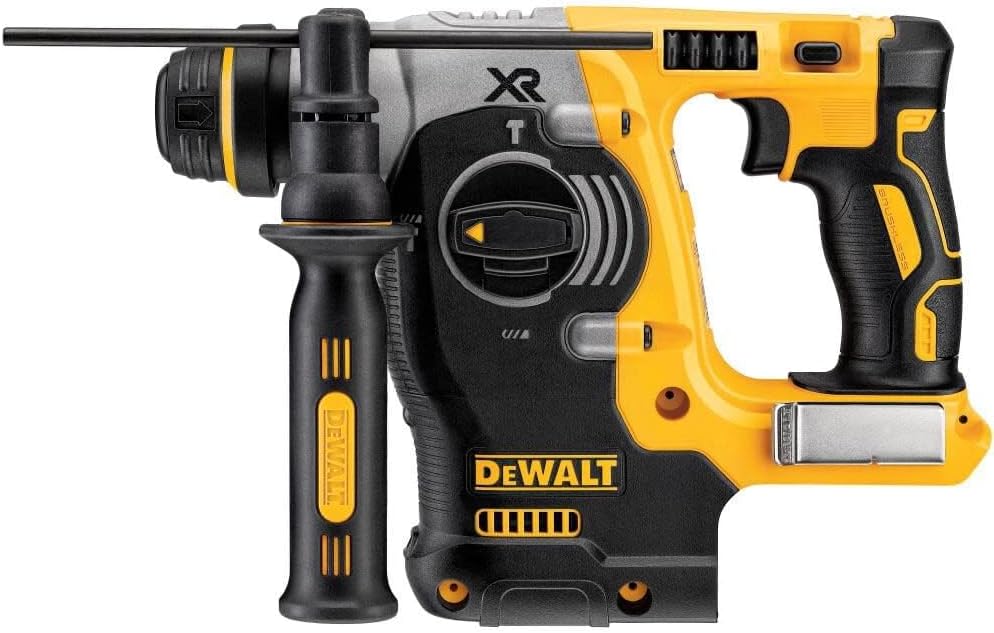
Summary
Editor's rating
Value for money: worth it if you actually drill concrete regularly
Design and ergonomics: not tiny, but manageable
Battery life and cordless convenience: the real reason to buy it
Comfort, vibration, and real-world fatigue
Build quality and durability: feels ready for jobsite abuse
Concrete performance: where it actually earns its keep
What you actually get with the DCH273B (and what you don’t)
Pros
- Drills 3/8"–1/2" holes in concrete quickly and with less effort than standard hammer drills
- Cordless with good runtime on 5Ah batteries, very convenient on sites with limited power
- Decent vibration control and ergonomics for a mid-size SDS hammer
Cons
- Bare tool only – batteries, charger, and case cost extra if you don’t already have them
- Gets heavy with a 5Ah battery, especially for extended overhead work
- Not ideal for heavy demolition or constant large-diameter drilling

Specifications
View full product page →| Brand | DEWALT |
| Power Source | Battery Powered |
| Maximum Rotational Speed | 1100 RPM |
| Voltage | 20 Volts |
| Maximum Chuck Size | 20 Millimeters |
| Color | Multi |
| Included Components | DCH273 Rotary Hammer | 360° side handle | Depth Rod | Adjustable Hook |
| Special Feature | Brushless Motor,Lightweight,Cordless |
Corded power without dragging a cord around?
I’ve been using the DEWALT 20V MAX SDS Rotary Hammer (DCH273B, bare tool) for a few weeks on and off, mostly for drilling concrete in a basement remodel and some outdoor anchor work. I already own regular 20V DeWALT drills with a “hammer” mode, and I’ll be blunt: those struggle in real concrete. This one is a different class. It’s not some magic tool that replaces every corded rotary hammer on the planet, but it finally feels like a proper SDS hammer that just happens to run on a battery.
In practice, I used it for things like 3/8" and 1/2" holes for wedge anchors, Tapcons, and a couple of small chisel jobs to clean out old mortar. With a 5Ah battery, I could get through a decent session of drilling without constantly swapping packs. I’m not a full-time concrete contractor, but I do enough heavy DIY and occasional side jobs to know when a tool is just hype. This one is actually useful, not a toy.
Is it perfect? No. It’s not super light once you add a 5Ah battery, and the bare-tool price isn’t cheap, especially since you still need batteries and a charger if you’re not already in the DeWALT ecosystem. Also, the 1" class rating is realistic: it’s happy in the 3/8" to 5/8" range; if you try to hog out big deep holes all day, you’ll feel its limits. But for typical anchors and light chiseling, it gets the job done without drama.
If you already have 20V MAX batteries and you’re tired of burning up normal drills in concrete, this SDS makes sense. If you only drill a couple of holes a year, it’s probably overkill and you’d be fine renting a corded rotary hammer when you need it. I’ll break down where it shines and where it’s just “okay” in the next sections.
Value for money: worth it if you actually drill concrete regularly
On price, the DCH273B isn’t cheap, especially since it’s a bare tool. If you’re starting from zero and have to buy batteries and a charger, it gets expensive fast. But compared to corded SDS hammers from brands like Hilti or even higher-end Bosch models, it’s still more affordable, and you’re getting cordless convenience on top. For someone already invested in DEWALT 20V MAX batteries, the value looks a lot better.
Where it really makes sense is if you drill concrete and masonry often enough that a regular hammer drill just isn’t cutting it. If you’re burning out standard drills, wasting time on every hole, or constantly borrowing/renting a corded rotary hammer, this tool pays for itself pretty quickly in time and frustration saved. It’s not the cheapest option out there, but it sits in a sweet spot between homeowner junk and super high-end pro-only tools.
If you only need to drill a couple of holes a year, I’d be honest and say: this is probably overkill. You’d be better off renting a corded SDS for a day or buying a cheaper hammer drill and living with slower performance. Also, if you don’t already own 20V MAX batteries, I’d seriously factor that into your decision. Buying into a new battery platform just for one tool is hard to justify unless you plan to add more tools later.
Overall, I’d call the value “good but not crazy good.” You’re paying for a proper SDS hammer that’s cordless and well-built, and you get that. There are cheaper hammers, there are stronger ones, but this one hits a nice balance for serious DIYers and many trades who want mobility without giving up too much power.
Design and ergonomics: not tiny, but manageable
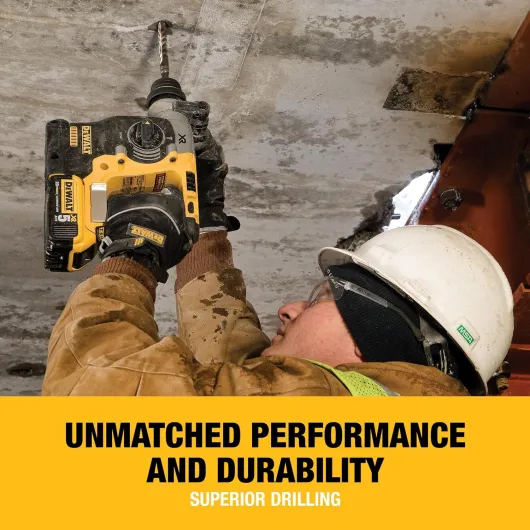
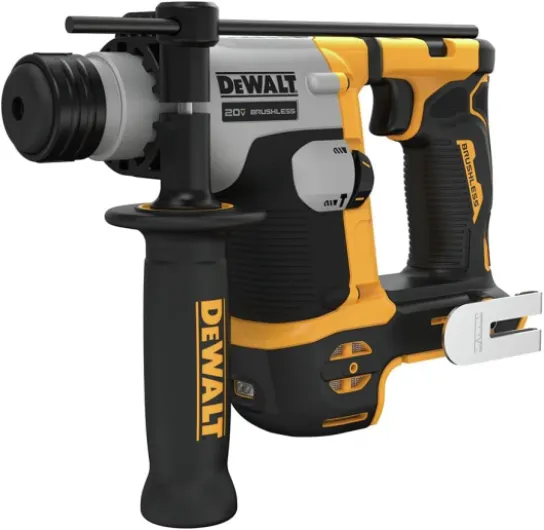
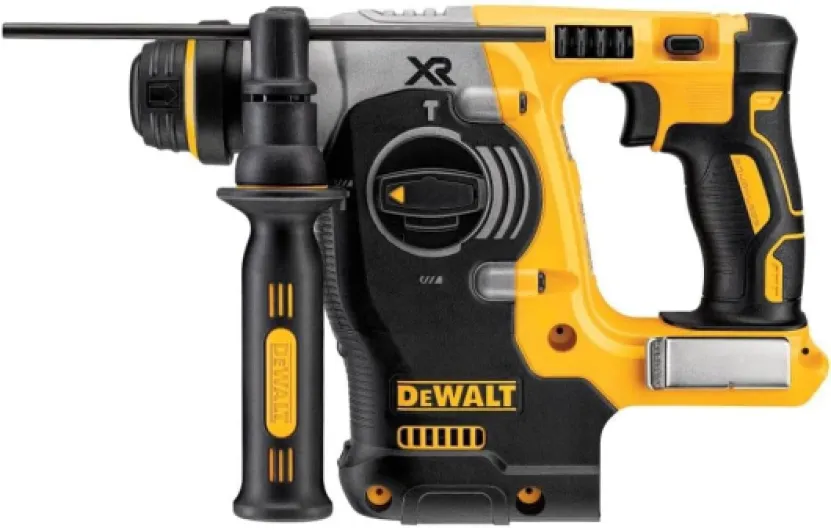
Design-wise, the DCH273B is pretty much what you’d expect from DEWALT: yellow and black, slightly chunky, and clearly aimed at jobsite abuse rather than looking pretty. It weighs about 5.9 lbs bare, and once you slap a 5Ah battery on it, you really feel it. It’s not featherweight, but for an SDS rotary hammer, it’s actually on the lighter side. For overhead work drilling anchors in a ceiling, I could manage it, but after a few dozen holes you do feel it in your shoulders.
The main handle and the side handle are the big plus points. The rubber overmold on the rear grip is decent; it doesn’t feel cheap or too hard, and it doesn’t get slippery when you’re sweaty or dealing with a bit of dust. The 360° side handle lets you lock it in any position, and I used it both horizontally and almost vertical when drilling into foundation walls. The depth rod is simple but handy; I actually used it instead of guessing depth like I usually do.
The mode selector dial on the side is well laid out. You get clear icons for drill, hammer drill, and chip, and the detents are strong enough that you don’t accidentally bump it into another mode. The trigger has good control; I could feather the speed at the start of a hole and then pull full power once the bit was lined up. There’s no fancy digital screen or nonsense – just a straightforward trigger and a mechanical dial, which I prefer on a tool that’s going to get banged around.
One thing I noticed: the balance with a 5Ah battery is slightly rear-heavy, which is actually good for control when you’re pushing into a wall. It’s less ideal if you’re reaching far out or drilling above shoulder height for long stretches, but that’s the reality with most cordless SDS hammers. Overall, the design is practical and work-focused. It’s not the most compact tool ever, but it’s well thought out and doesn’t feel like they cut corners on the important stuff.
Battery life and cordless convenience: the real reason to buy it
I ran this mostly on 20V MAX 5Ah batteries, which is what DEWALT often bundles with their XR tools. With a fresh 5Ah pack, drilling 3/8" and 1/2" holes in concrete, I was getting roughly 40–60 holes per battery depending on depth and how hard the concrete was. That’s not a lab test number, just what I saw over a few jobs. For a typical DIY day, one or two batteries were plenty. For a pro doing anchors all day, you’d want several batteries on rotation and a fast charger nearby.
The big benefit is simple: no cord. Not being tied to an outlet or dragging a 50 ft extension cord through dust and rebar is a relief. I used it in a basement where outlets were limited and outside on a retaining wall where I would normally need a long cord. Just grab the tool and go. That alone made me reach for this instead of my corded hammer more often than I expected, even when the corded one might be slightly stronger for heavier work.
In terms of efficiency, the brushless motor helps. You don’t feel the tool bogging down as the battery drains, at least not until the very end. It keeps a fairly consistent punch until the pack is close to empty, then it just stops instead of slowly fading. That’s typical for these packs. Heat-wise, after a decent run of holes, the motor area was warm but not scary hot, and the battery stayed within normal temperature – no thermal shutdowns so far.
The downside is obvious: if you don’t already own DEWALT batteries, the total cost adds up fast. Also, if you try to run it on smaller 2Ah compact packs, you’ll drain them quickly and it feels a bit unbalanced. This tool really makes sense with 4–5Ah (or bigger) packs. So, cordless convenience is great, but you pay for it in both money and the need to manage your batteries if you use it heavily.
Comfort, vibration, and real-world fatigue
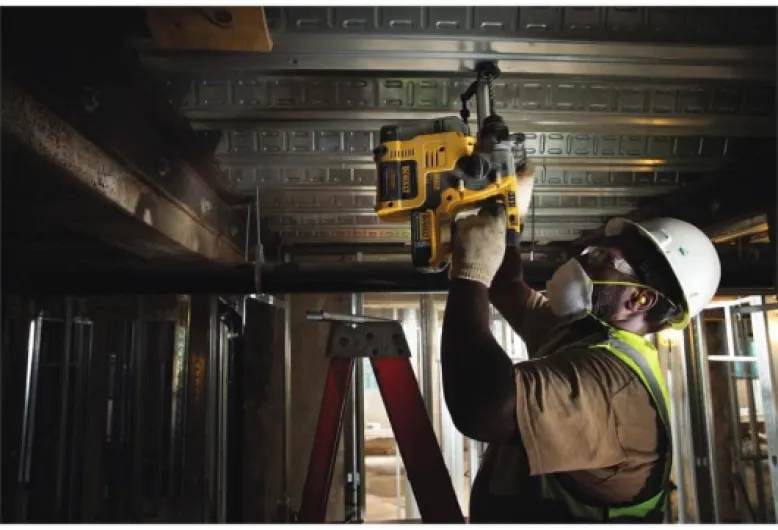
Comfort-wise, for an SDS hammer, it’s actually not bad. The SHOCKS Active Vibration Control isn’t just a sticker; you do feel less buzz in your hands compared to cheaper rotary hammers I’ve used. When I drilled a series of holes overhead for hanging strut, my arms were tired mostly from the weight, not from that numb tingling you sometimes get from constant vibration. It still vibrates – it’s a hammer drill, not a massage gun – but it’s more controlled and less harsh.
The grip shape is familiar if you’ve used other DEWALT 20V tools. The trigger is easy to modulate with one or two fingers, and the rubber overmold helps with grip. The side handle is what saves your wrists; I wouldn’t use this tool without it, especially in hammer mode. Once you lock that handle at the right angle, you can lean into the wall and let the tool do the work instead of muscling it the whole time.
On the downside, once you add a 5Ah battery, it’s not exactly light. Doing a handful of holes is fine, but if you’re spending a couple of hours drilling above shoulder height, you’ll feel it. That’s not unique to this model; most cordless SDS hammers in this size class are similar. I’d say for waist-height and below, the weight is totally manageable; for extended overhead work, you either need breaks or stronger shoulders than mine.
Noise is what you’d expect: loud but not insane. You still need hearing protection if you’re drilling more than a couple of holes. Dust-wise, I didn’t use the optional DWH303DH onboard extractor, just a helper with a shop vac for one job and solo drilling on others. With the dust extractor, I can see it being much more pleasant, especially indoors, but that’s another accessory to buy. Overall, comfort is decent for what it is: a compact SDS hammer that still packs a punch. Not painless, but definitely less punishing than older, rougher hammers.
Build quality and durability: feels ready for jobsite abuse
I haven’t owned it for years yet, but based on a few weeks of regular use and a bit of rough handling, the build quality seems solid. The casing is the usual DEWALT blend of hard plastic and rubber, and it doesn’t creak or flex when you lean into it. The SDS chuck locks bits in firmly; I never had a bit walk out or loosen, even when hammering into harder sections of concrete. The German-engineered mechanism claim is whatever, but the hammering action feels tight, not sloppy.
I dropped it once from about waist height onto a concrete floor (battery off, thankfully). It picked up a couple of scuffs on the plastic, but nothing cracked and it worked exactly the same afterward. That’s the kind of real-world test most tools eventually go through, and it passed without any drama. The mode selector still clicks cleanly, and there’s no weird rattle inside the body.
One thing I pay attention to is heat and smell during use. Some cheaper hammers start smelling like hot electronics after a few minutes of heavy drilling. This one got warm but didn’t stink or show any signs of being overstressed in normal use. The vents stayed reasonably clear, and there’s enough plastic around the motor that you’re not accidentally blocking everything with your hand.
Longevity is hard to judge this early, but the overall feel is that it’s built to survive jobsite use, not just weekend projects. The 3-year limited warranty is nice to have in the background, though I haven’t had to use it. Based on how it feels and how other DEWALT 20V tools of mine have held up, I’d expect it to last if you don’t drown it in dust or treat it like a demolition hammer 24/7. There are tougher, more industrial brands out there, but for the price and size, this is pretty solid in terms of durability.
Concrete performance: where it actually earns its keep
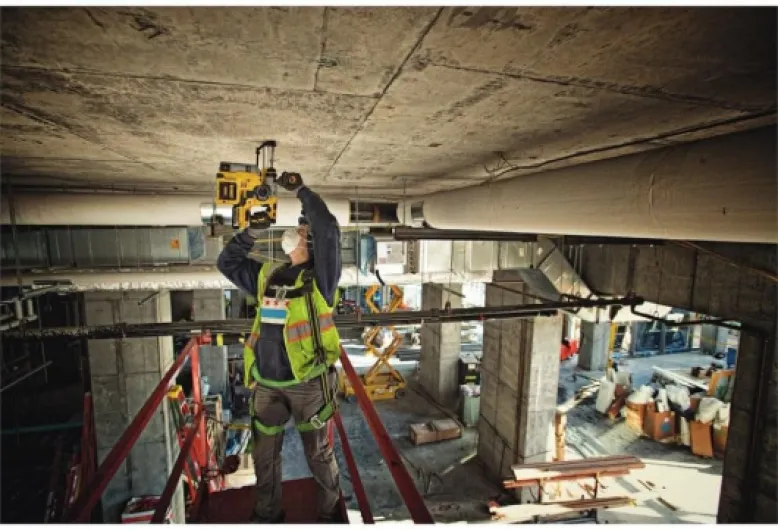
Performance is where this thing justifies the price. Compared to my regular 20V hammer drill (the typical 1/2" chuck style), the DCH273B is in a different league on concrete. I drilled about 30–40 holes for 3/8" wedge anchors in a poured concrete wall, and it chewed through them in seconds per hole instead of the “lean on it and pray” routine I’m used to. The 2.1 Joules of impact energy and SDS action make a real difference; you can feel the bit biting instead of just rattling.
In hammer drill mode with decent SDS bits, it went through old basement slab concrete about as fast as the corded Hilti I sometimes borrow from a friend. I’m not saying it’s better, but for 3/8" and 1/2" holes up to 3–4" deep, the speed was very similar. Where the corded Hilti pulls ahead is on bigger bits and long continuous runs – the DEWALT starts to feel a bit slower and you’re more aware of battery drain. For occasional 1" holes, it can do it, but I wouldn’t plan on doing that all day.
I also tried the chisel mode to knock out some loose mortar and clean around an old anchor. For light chiseling, it’s fine – it saves you from swinging a hammer and cold chisel. But if you’re thinking about breaking up a whole slab or doing serious demo, this is not the right size tool. It’s more for cleanup and small adjustments than real demolition.
One thing I really noticed is how stable it feels when the bit binds. On cheaper hammer drills, when the bit catches, the whole tool snaps your wrist. Here, between the SHOCKS vibration control and the side handle, the reaction is milder. You can still get a twist if you’re careless, but it’s more controlled. Overall, for drilling anchors and doing typical remodel work in concrete and masonry, the performance is pretty solid. It’s not a monster demolition hammer, but for what it’s built for, it gets the job done fast enough to feel professional, not like a compromise.
What you actually get with the DCH273B (and what you don’t)
The first thing to be clear about: this is the bare tool version. In the box I got the DCH273 rotary hammer, a 360° side handle, a depth rod, and an adjustable hook. That’s it. No battery, no charger, no case. If you’re not already on DEWALT 20V MAX, you’re looking at a bigger bill than just the tool price. For me, I already had several 5Ah batteries from other tools, so it slotted right in without extra cost.
The drill itself is a 20V brushless SDS-Plus rotary hammer, rated at 2.1 Joules of impact energy. In normal words, that means it hits harder than a regular hammer drill but it’s not some huge demolition hammer. It has a dial with three modes: drill only, hammer drill, and chisel (chip). I actually use all three: hammer drill for anchors, drill-only with an adapter for occasional non-concrete stuff, and chip mode for small breaking/clean-up jobs. The selector is clear and easy to flip with gloves on, which matters when you’re covered in dust.
Specs say up to 1" capacity in concrete and 1100 RPM. In real use, I mainly ran 3/8" and 1/2" bits, plus a 1" spade-type chisel. The SDS chuck is standard SDS-Plus, so all my existing SDS masonry bits clicked right in with no drama. Compared to my old corded hammer, it feels a bit shorter front-to-back, which helped when drilling close to walls and in tight basement corners.
Overall presentation is pretty straightforward: it’s clearly built as a jobsite tool, not a fancy kit for hobbyists. If you want foam-cut inserts, a case, or extra bits, you’re on your own. For me that’s fine; I toss it in a tool bag with the bits anyway. Just don’t expect a “starter kit” – this is more like adding another body to your existing 20V lineup.
Pros
- Drills 3/8"–1/2" holes in concrete quickly and with less effort than standard hammer drills
- Cordless with good runtime on 5Ah batteries, very convenient on sites with limited power
- Decent vibration control and ergonomics for a mid-size SDS hammer
Cons
- Bare tool only – batteries, charger, and case cost extra if you don’t already have them
- Gets heavy with a 5Ah battery, especially for extended overhead work
- Not ideal for heavy demolition or constant large-diameter drilling
Conclusion
Editor's rating
After using the DEWALT DCH273B on real concrete and masonry jobs, I’d sum it up like this: it’s a proper SDS rotary hammer that happens to be cordless, not a dressed-up regular drill. For drilling anchors, Tapcons, and doing light chiseling, it works fast, feels controlled, and doesn’t beat your hands up as much as older hammers. The 20V brushless setup with 2.1 Joules of impact energy is plenty for typical 3/8"–1/2" work, and the three modes (drill, hammer drill, chip) cover most things a remodeler or serious DIYer will need.
It’s not perfect. Once you add a 5Ah battery, it’s not exactly light, and if you’re not already in the DEWALT 20V ecosystem, the real cost includes batteries and a charger. It’s also not the tool for heavy demolition or constant large-diameter drilling; there are bigger corded and higher-voltage options that handle that better. But for anyone who regularly mounts anchors, hangs strut, or works on basements and slabs, the mix of power, cordless freedom, and decent comfort makes sense.
I’d recommend it to: people already on DEWALT 20V MAX who are tired of fighting with standard hammer drills in concrete, trades who want a reliable mid-size SDS for everyday anchor work, and serious DIYers who tackle more than just the odd weekend project. I’d skip it if you rarely touch concrete, are on a different battery platform and don’t want to switch, or if your main need is heavy demo rather than drilling. Overall, it’s a pretty solid cordless rotary hammer that does what it claims without a lot of nonsense.