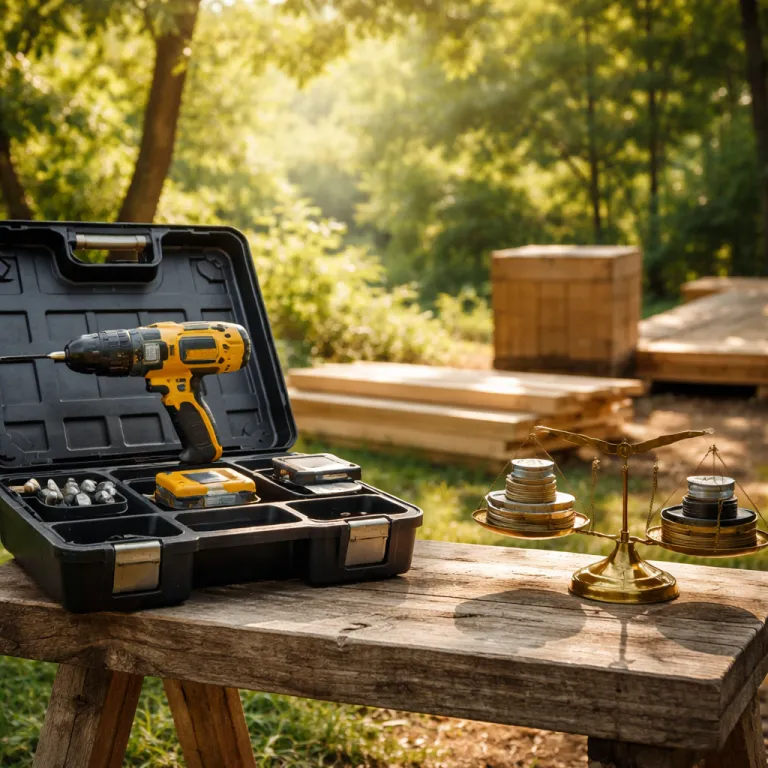
How a cordless drill tariff quietly adds $61 to the box
A cordless drill tariff–driven price jump in 2026 sounds abstract until you see the receipt. When a mid‑range DeWalt DCK283D2 kit moves from about $179 to roughly $240, that policy shift stops being a headline and becomes the reason you delay fixing a sagging deck stair. The new tariff structure on imported power tools and lithium‑ion batteries means every kit now carries a layered surcharge that most buyers never see itemized.
Here is how the duties stack in practice for tools imported from China. Under the Harmonized Tariff Schedule of the United States, cordless drills typically fall under HTS subheading 8467.11.00 for “rotary type, pneumatic or other tools for working in the hand,” which has a base duty rate published by the U.S. International Trade Commission.1 On top of that, Section 301 tariffs imposed by the Office of the U.S. Trade Representative add additional ad valorem duties on many Chinese power tools and lithium‑ion cells. Depending on the specific line item, combined statutory and Section 301 rates can exceed 30 percent on the tool portion and more than 50 percent on certain lithium‑ion battery packs, based on current USTR lists and USITC schedules.1 Because China still manufactures an estimated 80–85 percent of the cordless drill products sold in major U.S. retailers,2 those import duties hit almost every brand you see on the shelf.
Most companies do not break out these costs on the sticker, so the tariff impact shows up as a higher base price and fewer genuine discounts. When duties raise the landed cost of a hammer‑drill kit, retailers respond by nudging prices across the aisle, even on corded tools and bare multi‑tool bodies that are not directly subject to the same HTS codes. The result is a tool aisle where current trade policy, Section 301 actions, and lithium‑ion battery duties shape what you pay for everything from a basic 12‑volt drill/driver to a steel‑and‑aluminum cutting saw.
Consider a Milwaukee 2997‑22 hammer drill and impact‑driver combo that used to street at around $399. Under the new cost structure Chinese manufacturing faces, the same kit might carry $60 or more in added expense before it even reaches a regional warehouse, and that increase then compounds with normal distributor and retail markups. By the time it hits your cart, the effective price change can feel like a stealth tax on every deck screw you drive.
Because the duty rate applies to the declared customs value, not the final retail price, companies have a few levers. Some brands quietly downgrade included accessories or battery amp‑hour ratings to keep the declared cost lower, which means the higher trade costs sometimes show up as weaker power or shorter runtime instead of a bigger price tag. Others accept thinner profit margins for a season, hoping that Section 301 measures on Chinese goods might ease before buyers fully revolt at the register.
From a policy angle, these tariffs are framed around national security and a push to reduce reliance on Chinese imports for critical technologies. Power tools are not missiles, but lithium‑ion cells, steel, and precision electronics all sit inside the same global supply chains that governments now scrutinize, so cordless drill prices are partly collateral damage from a much broader strategic contest. For the DIY homeowner, though, the question is simpler and more practical, because you just want to know whether to buy now or wait.
A quick example of how $61 appears on the box. To keep the math concrete, assume a factory free‑on‑board (FOB) value of $130 for the drill and charger and $50 for the batteries, with Section 301 tariffs, base duties, and typical import fees rolled into the effective rates below. If combined duties and fees add roughly 34 percent to the tool portion and 54 percent to the battery portion, the landed cost becomes about $174 on the tool side ($130 × 1.34) and $77 on the battery side ($50 × 1.54), or $251 total before normal wholesale and retail markups. Even if retailers compress margins and promotional discounts bring the shelf price down to around $240, that still represents roughly $61 more than the original $179 street price once all layers of cost are accounted for.
Which brands are raising prices fastest, and why your old sale math fails
Not every brand feels these cordless drill cost pressures in the same way. Stanley Black & Decker, which owns DeWalt, Craftsman, and Porter‑Cable, has disclosed in past filings that a substantial share of its production footprint is in China and other low‑cost regions,3 so U.S. trade actions on Chinese goods hit a large slice of its catalog at once. Milwaukee and its parent TTI have been expanding assembly in the United States and Mexico, but those plants currently cover only a modest portion of their global supply, so most of their power tools still ride the same tariffed ocean lanes.
That uneven exposure shows up in how different brands handle costs and price hikes. Some companies are raising prices aggressively on flagship hammer‑drill kits while keeping entry‑level 12‑volt tools artificially low to hook new buyers into their battery platforms, which makes the new pricing landscape feel inconsistent and confusing. Others quietly shrink battery capacities or swap metal chucks for plastic to hold the shelf price while protecting profit margins from higher import costs.
Here is where your old sale instincts can mislead you badly. A 25 percent‑off promotion on a cordless drill set in the current environment may not beat the full price you could have paid before the latest duties, because base prices in the tool industry are already estimated to be 10–20 percent higher than they were the previous season. That means tariff‑driven increases can erase most of the headline discount before you even start comparing individual prices across brands.
Consider a Ridgid 18‑volt kit that used to be the go‑to budget hammer drill for many homeowners. When you see a heavily promoted $99 deal like the one analyzed in this Ridgid budget drill breakdown, you need to ask whether the new trade regime has been offset by cheaper internals, smaller batteries, or a stripped‑down accessory pack. Sometimes the costs are hidden in a weaker charger or a single 1.5 amp‑hour pack that forces you to buy an extra battery at full tariffed price later.
Brands that still lean heavily on Chinese factories for steel components, aluminum gear housings, and electronic speed controllers are especially exposed. When steel and aluminum inputs rise in cost due to both raw‑material markets and trade measures, the resulting price pressure ripples through every drill press, impact driver, and oscillating multi‑tool that shares those parts. Companies with more diversified supply chains in places like Mexico or Eastern Europe have a little more room to maneuver, but they are not immune to global supply shocks either.
Right now, the most honest way to think about cordless drill prices is to separate the tool from the platform. The bare drill body might only reflect part of the new cost structure, while the batteries and chargers carry the heaviest duties and the steepest price hikes. When you evaluate deals, focus less on the headline kit price and more on the long‑term costs of adding extra batteries and compatible tools over the next decade.
How manufacturers are reshaping supply chains, and what that means for your next kit
Behind the scenes, higher tariffs on Chinese power tools are forcing manufacturers to redraw their maps. Companies that once treated China as the default factory floor for cordless tools now talk about nearshoring, dual sourcing, and regionalized supply chains in every investor call. The goal is simple on paper: reduce reliance on any single country while still keeping costs low enough that a weekend warrior will not walk away from the aisle.
In practice, shifting a supply chain for complex tools is slow, messy, and expensive. Moving a hammer‑drill line from a Chinese plant to a facility in Mexico or the United States means rebuilding vendor networks for steel gears, aluminum housings, and lithium‑ion cells, and each new link in those supply chains adds its own risks and costs. During the transition, the impact of tariffs often shows up as temporary price hikes and limited stock, because companies cannot flip a switch and have fully localized production overnight.
Battery packs are the hardest part of this puzzle. The elevated duty rate on imported lithium‑ion batteries makes them the single biggest driver of cordless‑tool price inflation, yet most brands still source cells from Chinese or Korean suppliers tied into Chinese logistics hubs. Until large‑scale cell production ramps up closer to the United States, even drills assembled domestically will carry battery‑related price increases that reflect global supply constraints.
Some brands respond by pushing compact 12‑volt platforms more aggressively, because smaller packs use fewer cells and lower total material costs. If you read analyses on why professionals are quietly switching to 12‑volt drills for half their day, you will see how current trade policy nudges both pros and homeowners toward lighter tools for many tasks. That shift lets companies offer lower prices on certain products while still protecting profit margins on heavy‑duty 18‑volt and 20V Max kits.
Tool makers are also rethinking which tools they bundle together. Instead of selling a lavish combo with a drill, impact driver, multi‑tool, work light, and two large batteries, some brands now split those into separate products so the higher costs hit in smaller, more psychologically acceptable chunks. You might pay less at once, but over time the cumulative expense of building out a platform under current tariffs can exceed what a big combo would have cost before the policy change.
For buyers, the key is to understand that these corporate moves are not just abstract strategy. When a company shifts a line of power tools from China to a plant in the United States, the short‑term effect may still be rising prices because new facilities are less efficient at first, even if the long‑term goal is to stabilize costs. Today’s cordless drill pricing is therefore both a symptom of global supply realignment and a driver of the very changes that might eventually moderate prices.
Smart buying strategies when every kit carries a hidden tariff
So what should a homeowner actually do in the face of these cordless drill price shifts? The first step is to stop chasing headline discounts and start calculating total platform costs over the life of your tools, including extra batteries, chargers, and future bare tools. A $179 kit that locks you into very expensive batteries under current duties can be a worse deal than a $240 kit with more affordable ecosystem prices.
Look closely at the battery platform before you commit. If a brand is currently raising prices sharply on standalone packs, that is a sign its supply chain is absorbing significant tariff pressure, and you will feel those costs every time you expand your setup. Check whether the same batteries power a wide range of tools, from a hammer drill to a multi‑tool and a circular saw, because a broad ecosystem lets you spread trade‑driven price hikes across more useful products.
Refurbished and factory‑reconditioned kits deserve a fresh look right now. These tools were often imported before the steepest duties or were returned and repaired domestically, so the latest tariff layers may be less baked into their prices than into brand‑new stock. For a DIY homeowner who drills a few dozen holes a month, a reconditioned drill/driver with a solid warranty can be a very effective way to dodge some of the current costs.
Timing matters too, but not in the way it used to. Holiday sales that once offered genuine relief now sometimes just roll back recent increases to last season’s prices, so you need to compare against historical street prices, not just the crossed‑out number on the tag. When you see a supposed doorbuster, ask whether the kit configuration, battery sizes, and included tools have quietly changed to protect profit margins under the new trade regime.
Platform research is worth an evening of your time. Deep dives on choosing a cordless drill platform with confidence can help you understand which brands manage their supply chains more transparently and which ones rely heavily on Chinese imports for critical components. In a world shaped by shifting tariffs and Section 301 actions, that background knowledge is as valuable as knowing the difference between brushless motors and brushed ones.
Finally, match the tool to the work with ruthless honesty. If you mostly hang shelves, assemble furniture, and occasionally sink Tapcon anchors into a short run of concrete, you may not need the most powerful hammer drill in the aisle, and a mid‑tier kit will expose you to less long‑term platform cost. In the end, what matters is not the torque rating on the box, but whether your drill still drives the tenth deck screw at a frozen 6 a.m. without making you regret what you paid.
Key figures behind the new cordless drill economics
- The United States now applies additional Section 301 duties on many imported power tools under HTS 8467.11.00, layered on top of the base tariff rate published in the Harmonized Tariff Schedule, which directly contributes to the cordless drill price increases felt on most major brands.1
- Separate Section 301 tariffs on imported lithium‑ion batteries mean the battery portion of a cordless drill kit often carries the largest share of trade‑driven costs, especially on high‑capacity packs above 4 amp‑hours, according to current USTR duty lists and USITC classifications.1
- Industry estimates suggest that roughly 80–85 percent of power tools sold in the United States are manufactured in China, while only about 15–20 percent are produced domestically or in nearby countries, so U.S. measures on Chinese imports affect the vast majority of cordless drill products on American shelves.2
- Base prices for many mainstream cordless drill kits are currently estimated to be 10–20 percent higher than the previous season even before promotional discounts, meaning that a 25 percent sale today may not beat a full‑price purchase from before the latest tariff increases.
- Major companies with heavy Chinese manufacturing footprints, such as Stanley Black & Decker, face stronger pressure to raise prices or trim features than brands that have already diversified their supply chains into Mexico or the United States, as noted in recent Stanley Black & Decker Form 10‑K discussions of sourcing, regional manufacturing, and exposure to tariffs.3
- Industry analyses suggest that a mid‑range cordless drill kit that once retailed for about $179 can now effectively cost around $240 after layered tariffs, higher input costs for steel and aluminum, and standard retail markups are fully accounted for, producing an uplift of roughly $61 on the box.
1 Duty rates and classifications are based on the Harmonized Tariff Schedule of the United States (for example, HTS 8467.11.00 for certain hand‑held power tools) and Section 301 tariff lists published by the Office of the U.S. Trade Representative and the U.S. International Trade Commission; consult the latest official tables for current percentages.
3 Manufacturing footprint and sourcing details are summarized from recent Stanley Black & Decker Form 10‑K filings and related investor disclosures, including sections describing geographic distribution of production, reliance on Chinese suppliers, and sensitivity to tariffs and trade policy.