Summary
Editor's rating
Value for money: where it makes sense and where it doesn’t
Design: not fancy, but clearly built for concrete work, not Instagram
Comfort and vibration: better than a basic hammer drill, still a workout
Durability: feels tough, but here’s how it held up in real use
Performance: this is where it earns its keep
What you actually get in the box (and what you don’t)
Pros
- Drills through concrete and block quickly thanks to 3.0J impact energy and 8.5A motor
- Vibration control and clutch make it more comfortable and safer than cheap hammer drills
- Versatile modes (drill, hammer drill, chisel) cover anchors and light to medium demo in one tool
Cons
- Corded and fairly heavy, not ideal for quick or remote jobs without easy power access
- No bits or dust extractor included, so you need extra purchases to have a complete setup

Specifications
View full product page →| Brand | DEWALT |
A corded rotary hammer that actually feels worth dragging an extension cord for
I’ve been using the DEWALT D25263K SDS rotary hammer for a mix of jobs: drilling anchors in a garage slab, putting Tapcons in a block wall, and chipping up some old tile and thinset. I’m not a contractor with a crew, but I do enough concrete work that a basic hammer drill just wasn’t cutting it anymore. I bought this after fighting with a cordless hammer drill that overheated and ate batteries like crazy.
First impression: it’s not small, but it’s not a monster either. Once you pull the trigger in concrete, you understand what you paid for. It doesn’t feel like a regular drill with a bit of vibration; it actually hammers into the material the way an SDS should. I was drilling 3/8" and 1/2" holes in a cured slab, and it went through in seconds instead of minutes.
What pushed me to try this model was the combo of the 8.5 amp motor and the 3.0 joules impact rating. On paper, that doesn’t mean much to most people, but in practice it just means: you lean on it a bit, and it keeps going without bogging down. Compared to my old cordless hammer drill, this felt like stepping up a full category of tool, not just a slight upgrade.
It’s not perfect though. It’s a corded tool, it’s over 10 pounds with the case, and you’re not putting this in a kitchen drawer. But if you actually have concrete, block, or brick work to do, it finally feels like the tool is doing the hard part instead of your shoulders and patience. That’s basically what I wanted out of it.
Value for money: where it makes sense and where it doesn’t
Price-wise, the D25263K sits in that mid-range zone: not the cheapest SDS-Plus you can buy, but not in the pro-only pricing either. For what it does, I’d call the value pretty solid if you actually have regular concrete or masonry work to tackle. It’s strong enough that you’re not going to outgrow it quickly, but not so expensive that it feels like overkill for a serious DIYer or small contractor.
If you compare it to using a cordless hammer drill for the same jobs, you’re basically trading battery cost and frustration for a cord and higher upfront price. After fighting with my cordless on a concrete slab and burning through batteries, this corded DEWALT paid for itself in time and hassle saved. Also, you’re not buying extra batteries or worrying about one dying in the middle of a job. For stationary or near-outlet work like basements, garages, and patios, that’s a good deal.
On the flip side, if you just need to drill a couple of small holes in brick once a year, this is overkill. You’d be spending money on power you won’t really use, and you still have to buy SDS-Plus bits on top. Also, since it doesn’t come with bits or a dust extractor, expect to put a bit more into accessories. The compatible dust system is nice but not cheap, so if you’re working in finished spaces and care about dust, that’s another cost.
Overall, I think the value is best for people who: do renovations, install anchors regularly, remove tile, or deal with concrete more than occasionally. For them, this hits a nice balance of price, power, and durability. For light, once-in-a-blue-moon users, it’s probably more tool than needed, and a lower-end SDS or even a decent hammer drill might make more sense for the wallet.
Design: not fancy, but clearly built for concrete work, not Instagram
The design of this DEWALT is very much “tool first, looks second,” which I’m fine with. It’s a D-handle style rotary hammer, so the rear handle is like a pistol grip and there’s an auxiliary handle up front that you can rotate around the barrel. That layout makes it easier to control when you’re drilling overhead or into walls, compared to a big L-shaped SDS-Max. For drilling anchors in walls and ceilings, this shape makes sense.
The mode selector is on the left side and has clear icons for drill, hammer drill, and chisel. Switching modes is easy enough, though you do have to slightly wiggle the tool sometimes to get it to lock into place. Not a big deal, but it’s noticeable when you’re wearing gloves and tired. The depth rod is basic but works: I used it for consistent depth on anchor holes, and it stayed put once tightened.
One thing I noticed is the balance. The motor and hammer mechanism are up front, so the nose is heavier than the handle. When you’re drilling horizontally in a wall, that actually helps keep the bit against the surface. When you’re drilling downwards into a slab, your arms do a bit more of the lifting, but it’s still manageable. I never felt like it was trying to twist out of my hands, which is helped by the integral clutch when the bit binds.
My main complaint on design is storage and transport. The case is big and not super space-efficient, and the tool itself doesn’t have much in the way of onboard storage for bits or accessories. Also, there’s no belt hook or small hook to hang it up on a ladder, which would have been handy. Overall, though, the design feels like it was thought through for actual drilling and chipping, not just to look tough on a shelf.
Comfort and vibration: better than a basic hammer drill, still a workout
Comfort-wise, this is still a rotary hammer, not a featherweight drill. You feel the weight, but the SHOCKS vibration control does make a real difference compared to cheaper hammer drills I’ve used. When I was drilling about 24 holes in a flagstone over concrete patio, my hands weren’t buzzing for an hour afterwards, which is what usually happens with a cheap hammer drill. The rubber overmold on the handle and the way the rear handle is slightly isolated from the body help soak up some of the hit.
For longer sessions, like chipping tile in a kitchen, you do get tired, but it’s more from holding the tool up and moving it around than from harsh vibration. The trigger is easy to feather, and you don’t have to death-grip the tool to keep it under control. The side handle is thick enough to hold firmly with gloves, and it doesn’t rotate or slip once you lock it down. I pushed it pretty hard during tile removal, and the handle never loosened.
Noise-wise, it’s loud, as you’d expect from a rotary hammer, but it’s not worse than similar tools I’ve tried. Ear protection is still a must. The good part is you’re not stuck on each hole for ages. Because it drills quickly, the total exposure time to noise and vibration is lower than when you’re fighting with an underpowered hammer drill. So overall, it feels less punishing over a full day of work.
On the downside, if you’ve got weaker wrists or you’re not used to heavier tools, this will feel like a lot at first. The vibration control doesn’t make it soft or gentle; it just makes it more manageable. I wouldn’t hand this to someone who’s never used a power tool and say “have fun.” But for anyone who’s done some drilling before and just wants less hand-numbing shock, the comfort is pretty solid for what it is.
Durability: feels tough, but here’s how it held up in real use
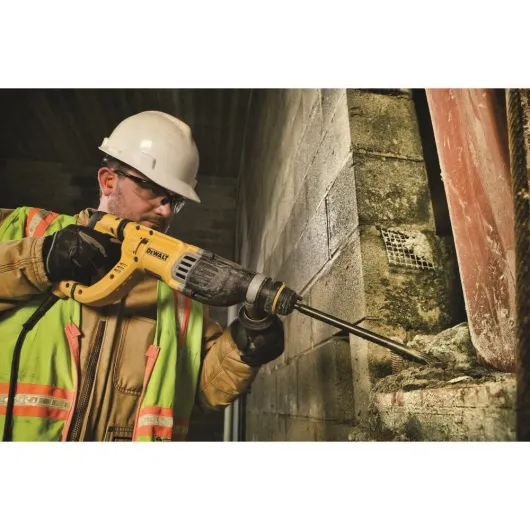
The tool is marketed as having a German-engineered mechanism, which basically means the hammering guts should be solid. I can’t see inside, but after several sessions of heavy use—tile demo, slab drilling, and some block wall work—there’s no play in the chuck, no weird noises, and no burning smell. The SDS-Plus chuck still locks bits in with a firm click and releases them without sticking, even after they’ve been hot.
The outer shell and rubber overmold have a few scuffs from being dragged around and tossed back into the case, but nothing has cracked or peeled. I accidentally knocked it off a low workbench onto a concrete floor once (not proud of that), and it survived with just cosmetic marks. The cord insulation still looks good, no kinks or cuts so far, though I try not to abuse it.
Heat management is decent. After continuous drilling, the front gearbox area gets warm, but not so hot you’re worried it’s cooking itself. I let it rest a few minutes between longer runs out of habit, but I never hit a point where I felt I had to stop to avoid damage. The vents do blow some dust out, so I try not to cover them with my hand when drilling in weird positions.
Long-term, the fact that DEWALT includes a 2-year free service is a nice safety net, but I haven’t had to use it. There are definitely more heavy-duty SDS-Max tools out there if you’re doing daily demo work, but for renovation, anchors, and medium chipping jobs, this feels built well enough to last several years if you don’t totally abuse it. I’d still blow it out with compressed air now and then and avoid leaving it buried in dust, just basic care to keep it going.
Performance: this is where it earns its keep
This is the main reason to buy this tool: it actually drills and chips concrete like it’s supposed to. The 3.0 joules of impact energy and 8.5 amp motor translate to real-world speed. In my tests on a garage slab, drilling 3/8" holes about 3 inches deep for wedge anchors took just a few seconds per hole. With a regular hammer drill, I’d be leaning on it, backing out to cool the bit, and generally wasting time. Here, you let the tool sit on the spot, apply light pressure, and it just eats through.
In cinder block and brick, it’s almost too easy. You have to be a bit careful not to blow out the backside of the hole by pushing too hard. For Tapcons and similar anchors, it’s very predictable: set your depth rod and just knock out a line of holes. I also used the chipping mode to remove old tile and thinset in a kitchen and dining area. With a wide chisel bit, it did the job steadily. It’s not as fast as a big SDS-Max demolition hammer, but for a tool that also drills, the chipping performance is decent and very usable.
The integral clutch came in handy a few times when the bit caught on rebar or a rock in the slab. Instead of the whole drill twisting your wrist, the clutch slipped and you just reset and tried again. That’s a big safety plus and also saves you from sudden shocks. The forward and reverse both feel strong, which is nice if you need to back out a bit that’s starting to bind.
If I compare it to a cordless hammer drill I own, there’s no contest. The cordless is fine for the odd hole in brick or block, but when I tried drilling into a thicker slab, it overheated, slowed down, and I burned through a battery for just a handful of holes. With this DEWALT corded SDS, I drilled dozens of holes in one go and the limiting factor was me, not the tool. So in terms of raw performance on masonry, it definitely gets the job done and then some.

What you actually get in the box (and what you don’t)
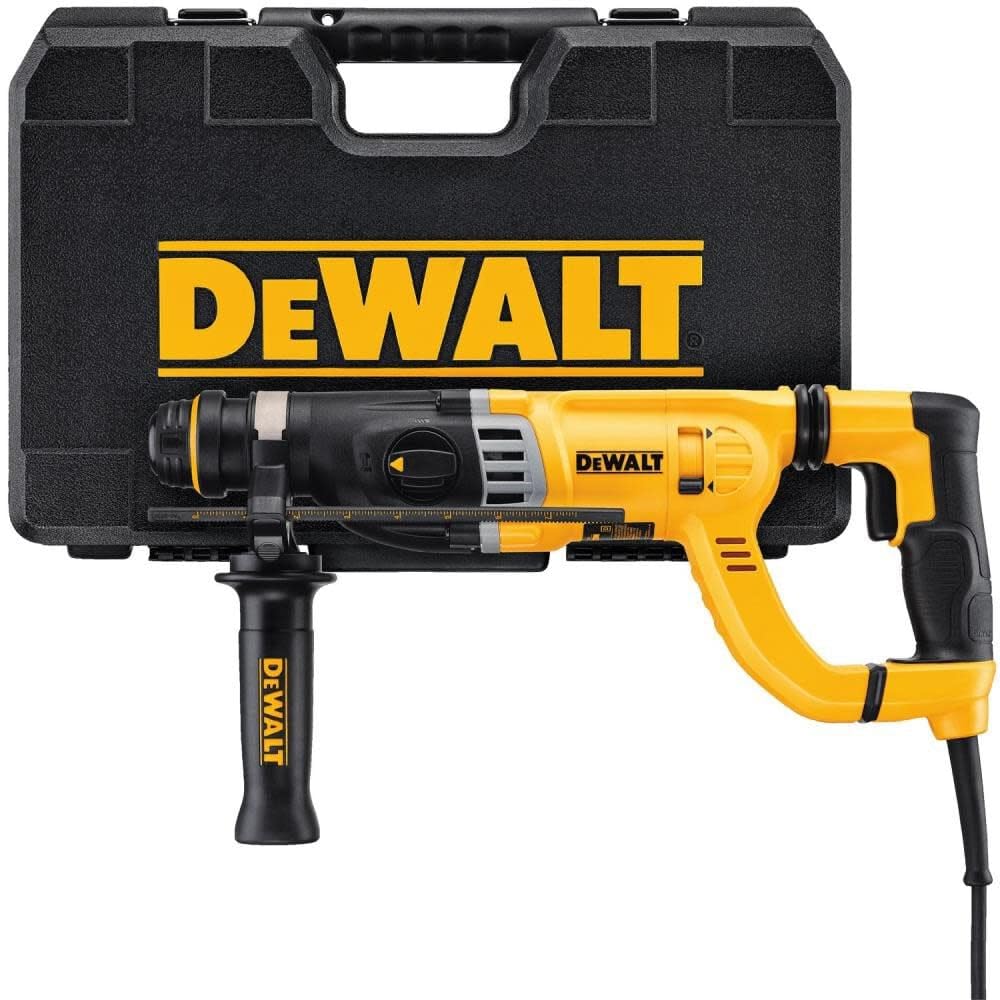
Out of the box, the D25263K is pretty straightforward: you get the rotary hammer, side handle, depth rod, and a hard plastic kit case. No bits, no dust extractor, no fancy extras. The case is bulky but decent. It’s big enough to toss in a small SDS bit set and some anchors, so you can keep everything together, which I appreciated on site. The latches feel okay, not tank-like, but they haven’t popped open on me yet.
The tool itself looks like a typical DEWALT: yellow and black plastic shell, rubber overmold on the grip, and a long cord. The cord length is decent for garage and indoor work, but outside I still needed an extension cord almost every time. The drill uses SDS-Plus bits, which is standard for this size. If you’ve only used regular hammer drills before, just know you’ll need SDS-Plus bits; your regular smooth-shank masonry bits won’t work.
Controls are simple: a main mode selector for drill, hammer drill, and chip-only, plus a trigger and forward/reverse switch. There’s also the rotation lock for setting chisel angle in chipping mode. Nothing feels confusing, which I like. You don’t have to read the manual for 20 minutes to figure it out; you can basically plug it in and go, as long as you know how to seat an SDS bit properly.
On the downside, the presentation is pretty barebones if you were hoping for a starter kit. No bits, no dust shroud, no carry strap. For the price, I wouldn’t have minded at least a basic SDS masonry bit thrown in, just to get going. Still, I’d rather they spend the cost on the internals and motor than on packing it with cheap accessories I’d replace anyway.
Pros
- Drills through concrete and block quickly thanks to 3.0J impact energy and 8.5A motor
- Vibration control and clutch make it more comfortable and safer than cheap hammer drills
- Versatile modes (drill, hammer drill, chisel) cover anchors and light to medium demo in one tool
Cons
- Corded and fairly heavy, not ideal for quick or remote jobs without easy power access
- No bits or dust extractor included, so you need extra purchases to have a complete setup
Conclusion
Editor's rating
After using the DEWALT D25263K on real jobs—drilling anchors in slab, punching holes in block, and chipping tile—I’d sum it up like this: it’s a straightforward, strong rotary hammer that actually makes concrete work feel manageable instead of miserable. The 8.5 amp motor and 3.0 joules of impact energy translate into fast drilling and decent chipping, and the vibration control makes longer sessions less punishing than with a basic hammer drill. It’s not light, but the balance and handles are well thought out, and the clutch helps protect your wrists when bits bind.
It’s not perfect. It’s corded, the case is bulky, there are no included bits or dust attachment, and for someone who only drills a couple of holes a year, it’s clearly more tool than necessary. But for serious DIYers and trades who regularly deal with concrete, block, or tile removal, it feels like money spent on something that actually works instead of fighting your tools. If you’re expecting SDS-Max demolition power, this isn’t that, but for most renovation and anchor work, it hits a good balance between power, comfort, and price.