Summary
Editor's rating
Value: good bang for the buck if you know what you’re buying
Design: compact, heavy enough, but not a precision instrument
Materials and build: heavy where it counts, a bit rough in spots
Durability: feels like it’ll last, with some maintenance
Performance: plenty of power, with a few realistic limits
What you actually get out of the box
Pros
- Sturdy cast iron construction with enough weight for stable drilling
- 6.2-amp induction motor and 5 speeds handle wood and typical metal jobs
- Good price-to-performance ratio for home and small-shop use
- Useful extras: laser guide, LED work light, and adjustable depth stop
Cons
- Only 2 inches of spindle travel, limiting deeper drilling without repositioning
- No rack-and-pinion table lift; height adjustment is manual and clumsy with heavy setups
- Fit, finish, and angle scales are basic, not ideal for high-precision work

Specifications
View full product page →| Brand | WEN |
A small drill press that actually feels like a real tool
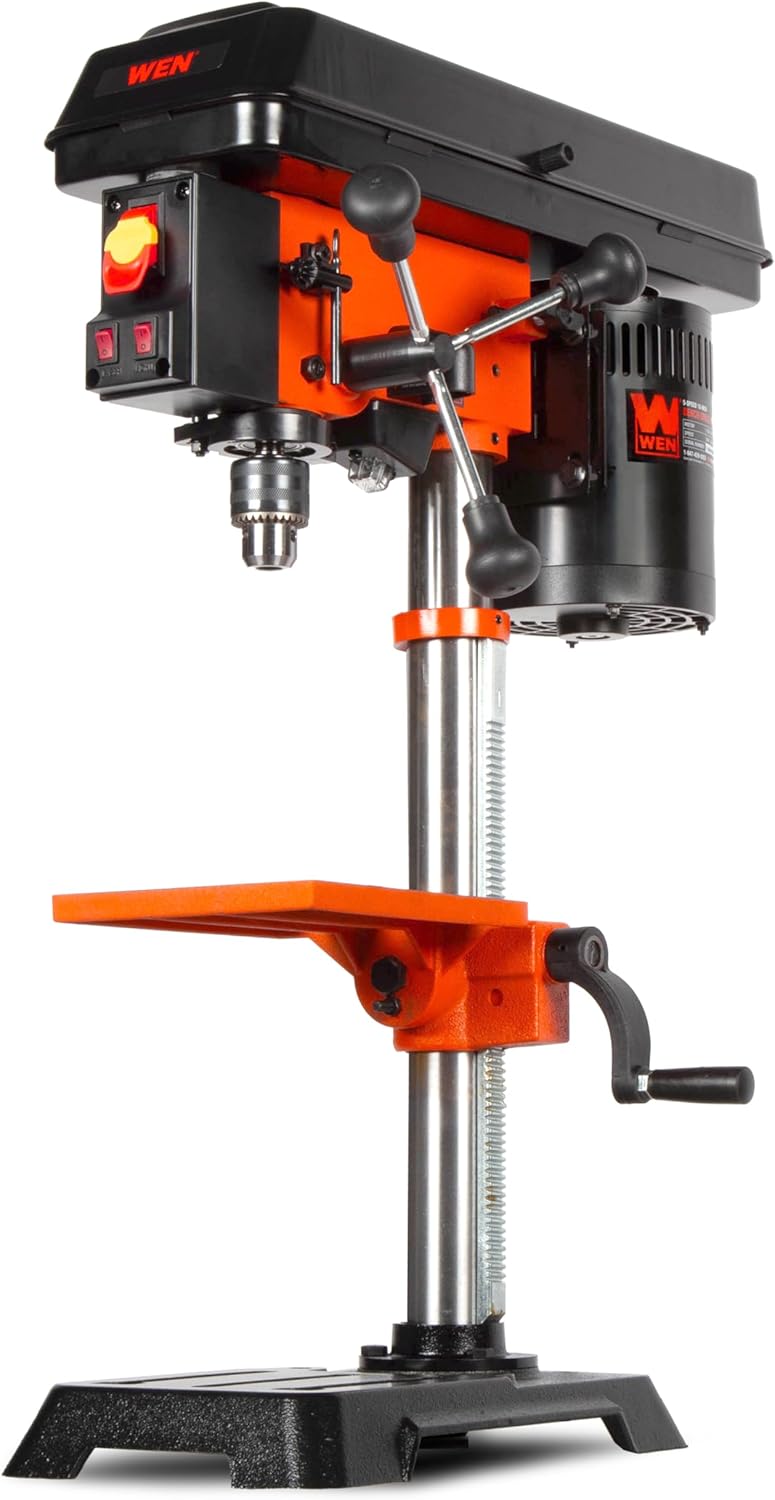
I picked up the WEN DP1050 10-inch drill press because I was tired of trying to drill straight holes with a handheld drill on a wobbly workbench. I don’t have a huge shop, just a corner of the garage, so a full-size floor press was overkill. This one sat in that sweet spot: not a toy, not industrial, just a compact press that looked like it could actually push through steel without crying.
After a few weekends of use on wood, aluminum, and some mild steel, I’d say it’s pretty much what you expect at this price: solid enough to trust, but not a precision machine-shop tool. It’s about control and repeatability more than raw power. If you’re used to cheap mini presses or drill stands, this is a big step up. If you’re coming from a big floor model, you’ll notice the limits right away.
In day-to-day use, the main thing that stands out is how *stable* it feels for its size. The cast iron base and head give it some real weight, and the motor doesn’t sound strained unless you’re doing something dumb like hogging through steel at the highest RPM with a dull bit. The laser and LED are not magic features, but they do help when you’re lining up holes on small parts.
It’s not perfect: table adjustments are a bit old-school, the belt speed changes are slightly annoying, and the 2-inch spindle travel can feel short when you’re working on thicker stock. But for a benchtop drill press under the fancy brands’ price range, it gets the basics right: straight holes, decent power, and a sturdy feel. That’s pretty much what I was looking for.
Value: good bang for the buck if you know what you’re buying
In terms of value, the WEN DP1050 sits in a nice spot. You’re paying roughly what you’d pay for a decent corded drill, and in return you get a proper benchtop press with cast iron construction, more power than the tiny mini-presses, and useful extras like a laser and LED light. Compared to the really cheap presses, the extra weight and sturdier build absolutely show in how stable it feels while drilling.
Is it the best drill press on the market? No. There are more precise, smoother, and better-finished presses out there, but they cost a lot more. At this price, you’re trading away things like a rack-and-pinion table lift, ultra-precise angle scales, and super-polished fit and finish. In return, you get a machine that gets the job done for most DIY and light shop tasks without draining your wallet. For someone setting up a first shop, or upgrading from a drill stand, it’s a big improvement without a big bill.
Where the value really shows is when you compare it to the tiny battery or mini drill presses that cost almost as much. Those often lack torque and rigidity, and feel more like gadgets than tools. This WEN has enough motor, enough mass, and enough travel to feel like the real thing, even if it has its limits. You also get a two-year warranty and a brand that a lot of hobbyists already use for other tools, so you’re not dealing with some no-name import with zero support.
If you want perfect precision for metal machining or constant heavy-duty work, you’ll outgrow this and should budget for a bigger floor model from a higher-end brand. But if your reality is weekend projects, furniture builds, brackets, jigs, and the odd metal job, the value is pretty solid. You’re not paying for bells and whistles you’ll never use—just a straightforward drill press that does the basics well enough for the money.
Design: compact, heavy enough, but not a precision instrument
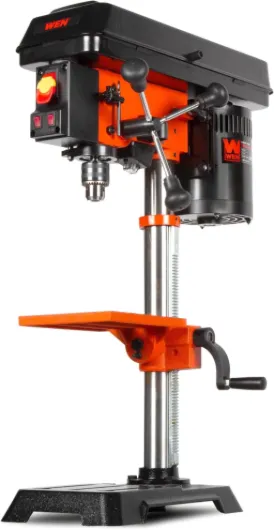
The design is pretty typical benchtop drill press: cast iron base, steel column, cast iron head and table. What I noticed first is the weight. At around 50 pounds, it’s not something you casually slide around with one hand, which is a good thing—less walking across the bench while you’re drilling. The orange finish is standard WEN branding, and while I don’t care about color, it does make it easy to spot knobs and levers against the darker metal parts.
The controls are basic but functional. You’ve got the three-spoke feed handle on the right, an on/off switch with a removable safety key on the front, and a simple depth stop setup on the quill. The depth stop is basically a threaded rod with nuts you lock in place, which is old-school but it works. Once you dial it in, you can repeat consistent-depth holes for things like dowels or countersinks. The front-facing laser is laid out in an X pattern that crosses roughly where the bit lands. Mine needed a small tweak to be dead-on, but once dialed, it was close enough for wood and basic metal work.
The big design compromise is the table adjustment system. The table slides up and down the column with a clamp; there’s no rack-and-pinion crank. So you loosen the clamp, manhandle the table to roughly the right height, then tighten it again. For light pieces, that’s fine. When you’ve got a heavier jig or vise on it, it’s a bit of a pain. You can tilt the table 45° left and right using the bolt underneath, and there’s a small angle scale on the back, but it’s not a super-precise setup—you’ll still want a square or digital angle gauge if angle accuracy matters.
In practice, the design tells you exactly what this machine is for: general-purpose drilling where you care more about straight holes and power than micrometer-level alignment. The head is secured to the column with set screws, which is normal at this level, but it does mean I double-check them now and then to be sure nothing has shifted. It’s not fancy, but it’s functional, and once you accept that it’s a hobby/DIY-class tool, the design choices make sense.
Materials and build: heavy where it counts, a bit rough in spots
Material-wise, WEN didn’t cheap out on the important parts. The base and table are cast iron, the column is a solid steel tube, and the head casting feels beefy. That’s what gives this little press its stability. Once it’s bolted to the bench, nothing flexes in a scary way. Compared to the really lightweight presses you see in discount stores, this feels like a proper tool, not a wobbly stand for a motor.
That said, the finish is not perfect. The machining on the table and base is flat enough for normal use, but you’ll see small casting marks and paint edges that aren’t pretty. The column on mine was smooth and straight, but the clamp surfaces on the table mount needed a quick wipe and a bit of attention to get rid of shipping crud. Nothing major, just not showroom-level. The pulleys are metal, not plastic, which I like. The belt itself is standard fare—if it ever wears out, you can replace it easily with a generic one.
The chuck is a 1/2" keyed style, and it’s decent. It’s not a high-end precision chuck, but it grips bits firmly and doesn’t slip under normal torque. I like that WEN added a little storage clip on the side of the head for the chuck key; it sounds minor, but it saves you from hunting for it every time. The feed handles are fine, though they feel a bit small considering the overall mass of the machine. That’s not really a problem—if anything, it keeps you from leaning on it too hard and abusing the bearings.
Overall, the materials match the price point: solid where it matters, a bit rough around the edges visually. If you’re expecting polished castings and flawless paint, you’ll be disappointed. If you just care that the column is rigid, the base is heavy, and the motor is reliable, then this checks those boxes. After some use, nothing has loosened up or started rattling, so from a materials and build standpoint, it feels like it’ll hold up for normal home and small-shop use.
Durability: feels like it’ll last, with some maintenance
I haven’t owned this for years yet, but based on a few months of weekend use, it gives the impression of being a long-term tool, not something that will die in a year. The induction motor is the big plus here—these motors tend to last a long time if you don’t abuse them. Running it for longer drilling sessions (batch drilling in hardwood and some steel brackets), the motor got warm but not scary hot, and there was no burning smell or weird noises.
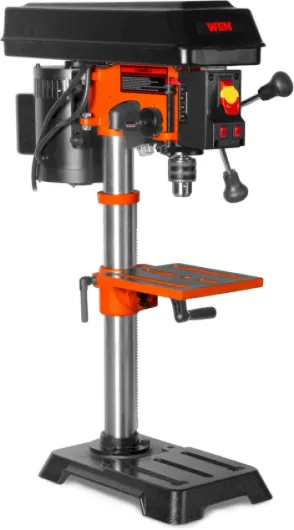
The weak points on cheaper presses are usually the bearings, the belt system, and the table clamp. So far, the quill still moves smoothly with no noticeable play, and there’s no new wobble after some use. I do make a habit of checking the head mounting set screws and the table clamp bolt every now and then, especially after heavier metal work. That’s just basic drill press care, and on a benchtop model held together with set screws, it’s even more important. Keep those tight and you avoid surprises when you pick it up or tilt it.
The paint and finish are holding up fine. The table will scratch if you slide steel parts around on it, but that’s normal for any cast iron surface. I threw a sacrificial board on top for most wood work and a small drill press vise for metal, which also protects the table. The belt hasn’t shown any signs of fraying or cracking yet. If you’re changing speeds a lot, just make sure you’re not over-tensioning it; too tight and you’ll wear the belt and stress the bearings for no reason.
I’d say, with basic maintenance—keeping it clean, occasionally oiling the column, not forcing dull bits through metal—this press should easily handle years of hobby and light professional use. If you’re planning to run it like a production machine eight hours a day, that’s stretching it beyond what it’s built for. But for a garage shop, school/youth group wood shop, or a small fabrication bench, the durability feels good for the price, especially with the two-year warranty as a bit of backup.
Performance: plenty of power, with a few realistic limits
Performance-wise, this thing does what I bought it for: drill straight, controlled holes in wood and metal without drama. The 6.2-amp induction motor has more than enough power for typical shop tasks. I’ve run it through 3/4" oak, 2x lumber, and 1/4" mild steel plate. In wood, even with a 1/2" bit, it just cruises if you pick the right speed. In steel, you do have to respect the rules—low speed, cutting oil, sharp bits—but it handles it. I drilled a series of 3/8" holes in 1/4" steel angle, and the press didn’t bog down; the limiting factor was heat in the bit, not the motor.
The five speeds are spaced well enough. I mostly use 630 or 1100 RPM for metal, and 1800 or 2450 for wood. 3300 is nice for small pilot holes or tiny bits. Changing speeds means opening the top cover and moving the belt across the pulleys. It’s not hard, but it’s not instant either, so you tend to group tasks by material and bit size to avoid flipping speeds every five minutes. Belt tracking has been fine so far—no squeals or slipping once tensioned correctly.
Runout (wobble at the bit) is the big question on cheaper drill presses. On mine, with a decent-quality bit, it’s minimal enough that it doesn’t show up in normal drilling. I’m not measuring thousandths of an inch, but for woodworking and general metal fab, holes are round and land where I expect. The laser helps for lining up, but I don’t treat it as absolute truth. The spindle travel of 2 inches is probably the most noticeable limit. If you’re drilling deep holes in thicker stock, you’ll hit the stop and have to raise the table or flip the piece. For most hobby work it’s fine, but if you regularly drill through 4x4 posts or thick blocks, it will start to annoy you.
Noise level is actually pretty decent. The induction motor just hums, and most of the sound you hear is the bit cutting. Compared to a screechy cheap drill or a high-RPM handheld, it’s a lot more pleasant. Overall, for a sub-$200 benchtop press, the performance is solid: it has the torque, it tracks straight enough, and it feels stable under load. Just don’t expect industrial speed changes or deep spindle travel, and you’ll be happy enough with how it runs.
What you actually get out of the box
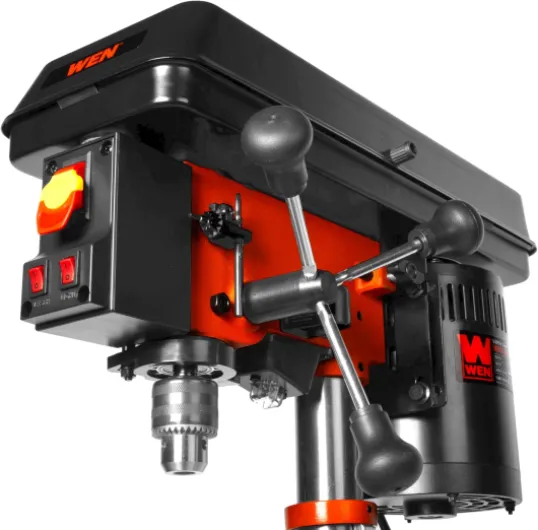
Out of the box, the WEN DP1050 looks like a real drill press, just shrunk down a bit. You get the main head and motor assembly, the column, the cast iron base, the tilting table, the 1/2-inch chuck already on the spindle taper, the chuck key (with a little storage clip), and the usual bag of bolts and knobs. There’s also the laser module and an LED work light built into the head, which are already wired in, so no separate power supply or weird add-ons.
Assembly is straightforward: base to column, column to head, then bolt on the table. It’s not rocket science, and it took me around 30–40 minutes taking my time, including wiping off the shipping grease. The manual actually tells you to clean the column and spindle area before use, and I’d agree—mine had a light oil film that would definitely make things slip if you ignored it. Once it’s together, the whole unit stands about 28–29 inches tall, and the base footprint is roughly 8 x 13 inches, so it doesn’t swallow your bench.
In terms of specs in practice: you get 5 speeds (630, 1100, 1800, 2450, 3300 RPM) by moving the belt across two pulleys under the top cover. The swing is 10 inches, which basically means you can drill roughly 5 inches from the center of the bit to the column. Spindle travel is 2 inches, so that’s your maximum plunge without repositioning. The chuck accepts 1/16 to 1/2 inch bits, which covers most normal shop drilling without needing an upgrade right away.
Overall, the presentation is pretty honest: this is a compact, cast-iron benchtop drill press with a few convenience features (laser, light, depth stop) but no fancy digital readouts or geared table lift. It looks and feels like a budget-friendly tool meant for hobbyists, DIYers, or a small wood/metal setup, not a production shop. If you’re expecting ultra-fine machining, you’re in the wrong price bracket. If you just want consistent, straight drilling with some flexibility, the feature set makes sense.
Pros
- Sturdy cast iron construction with enough weight for stable drilling
- 6.2-amp induction motor and 5 speeds handle wood and typical metal jobs
- Good price-to-performance ratio for home and small-shop use
- Useful extras: laser guide, LED work light, and adjustable depth stop
Cons
- Only 2 inches of spindle travel, limiting deeper drilling without repositioning
- No rack-and-pinion table lift; height adjustment is manual and clumsy with heavy setups
- Fit, finish, and angle scales are basic, not ideal for high-precision work
Conclusion
Editor's rating
Overall, the WEN DP1050 10-inch benchtop drill press is a solid choice for a small shop or garage if you want straight, repeatable holes without jumping into pro-level pricing. The cast iron build gives it enough weight to stay put, the 6.2-amp motor has enough muscle for wood and typical metal work, and the 5-speed belt system covers most common drilling tasks. The laser and LED are nice bonuses, not essential, but they do make setup a bit easier, especially on smaller parts.
It’s not perfect. The 2-inch spindle travel feels short if you often drill deeper stock, the table height adjustment is basic and a bit clumsy with heavier setups, and the overall precision is good for DIY and light fabrication, not for machinist-level work. Fit and finish are functional rather than pretty, and you’ll want to spend a bit of time dialing in the laser and checking bolts after setup. But once you know those limits, it’s a tool you can rely on for most everyday drilling jobs.
If you’re a hobby woodworker, a DIYer, or running a small youth group or school shop, this is a good value for money option that feels like a real machine, not a toy. If you’re doing serious metal fabrication all day, or you’re picky about ultra-precise angles and repeatability, you should probably skip this and aim higher up the price ladder. For the average home shop, though, it hits a nice balance between price, power, and practicality.