Summary
Editor's rating
Value for money: worth it if you already run DEWALT 20V
Design and handling: compact, front-heavy, but manageable
Battery life and power: solid with 5Ah, less fun with small packs
Durability and build: feels tough, but not bulletproof
Performance in concrete and masonry: what it actually does on the job
What you actually get with the DCH273B (and what you don’t)
Pros
- Drills anchors and medium holes in concrete much faster than a standard hammer drill
- Cordless design with decent runtime on 5Ah batteries, very handy on ladders and around the house
- Three modes (drill, hammer drill, chip) make it versatile for anchors, light chiseling, and general work
Cons
- Sold as bare tool only, real cost climbs if you don’t already own DEWALT 20V batteries
- Not ideal for heavy demolition or very large holes all day long
- Smaller batteries (2–3Ah) run out fast, practically needs 4–5Ah packs for comfortable use

Specifications
View full product page →| Brand | DEWALT |
A cordless rotary hammer that finally replaces the corded one (most of the time)
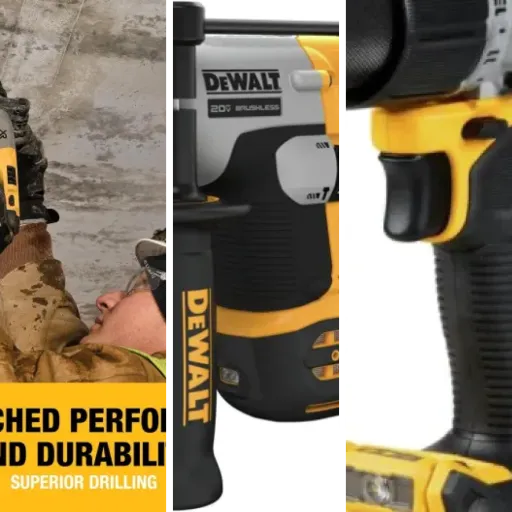
I’ve been using the DEWALT 20V MAX SDS Rotary Hammer Drill (DCH273B, bare tool) for a mix of home projects and a few small paid jobs. I already had a pile of DEWALT 20V batteries and a couple of standard hammer drills, but they always felt like they were pretending to be real concrete tools. I bought this one specifically to drill anchors into poured concrete and block walls without dragging cords everywhere.
In real use, this thing is clearly a step above a regular hammer drill. When you pull the trigger in hammer mode on concrete, you can feel it actually chiseling instead of just rattling. I used it for Tapcon holes in a garage slab, some 1/2" holes in a foundation wall, and a few quick chipping jobs. It gets through concrete fast enough that you’re not standing there getting annoyed at every hole.
It’s not perfect though. It’s not as strong as a big corded SDS or a heavier SDS-Max, and if you plan on drilling big holes all day, you’ll hit its limits. Also, remember this listing is bare tool only, so if you don’t already have DEWALT 20V batteries and a charger, the real cost jumps quickly. That part is easy to miss if you just look at the price and hit buy.
Overall, after using it for several weekends, my honest take is this: as a cordless rotary hammer for anchors, light demo, and general concrete work, it gets the job done and makes life easier. It’s not cheap and it’s not a monster tool, but for typical DIY and light pro use, it’s a pretty solid balance of power, weight, and convenience.
Value for money: worth it if you already run DEWALT 20V
Price-wise, the DCH273B sits in that mid-to-upper range for a bare tool SDS-Plus rotary hammer. It’s not the cheapest option out there, especially if you compare it to some lesser-known brands or corded units. But you’re paying for cordless convenience, a brushless motor, and the DEWALT 20V ecosystem. If you already own multiple DEWALT batteries and chargers, the cost stings less and the tool makes more sense.
Where it earns its keep is the time and hassle it saves. Not dragging cords, not hunting for outlets, and not fighting with underpowered hammer drills in concrete does add up. For me, one job where I drilled a bunch of holes in a basement slab and foundation wall basically justified the purchase in terms of time saved and not burning out a regular drill. If you’re someone who does concrete anchors regularly, that matters.
On the downside, if you’re starting from scratch with no DEWALT batteries, the total price (tool + at least one 5Ah battery + charger) gets high pretty fast. In that situation, a corded SDS-Plus from a decent brand might make more sense financially, especially if you don’t care about being cordless. Also, if you only drill a couple of holes a year, this is overkill; you’d be better off renting a hammer drill when you need it.
Overall, I’d say the value is good but not mind-blowing. For someone already in the DEWALT 20V lineup who wants a real rotary hammer instead of abusing a regular drill, it’s a smart upgrade. For a very occasional user with no DEWALT gear, it’s harder to justify and there are cheaper ways to put a few holes in concrete.
Design and handling: compact, front-heavy, but manageable
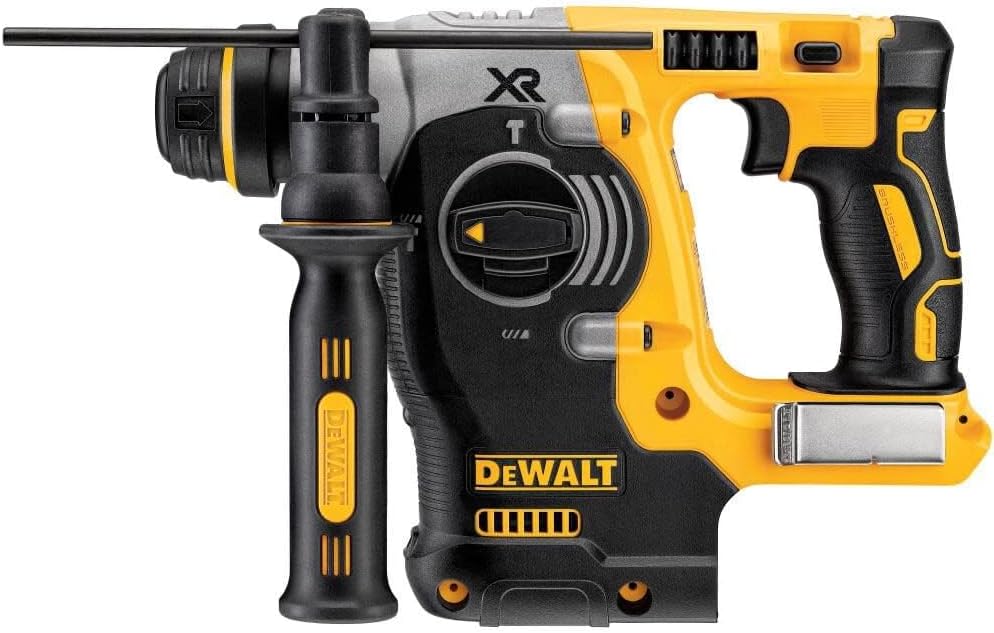
In the hand, the DCH273B feels like a typical SDS-Plus rotary hammer: a bit front-heavy because of the mechanism and chuck, but not ridiculous. It’s about 5.9 lbs bare, and once you slap a 5Ah battery on it, you’re closer to the 7 lb range. That’s still lighter than many corded SDS drills I’ve used, especially older ones. The grip angle is decent, and the rubber overmold helps when your hands are sweaty or dusty.
The mode selector dial on the side is pretty straightforward: you’ve got icons for drill, hammer drill, and chip. You can switch modes easily, but like most rotary hammers, you want to stop the motor before flipping it, otherwise it feels crunchy. The side handle rotates 360° and locks firmly; I cranked on it pretty hard drilling overhead and it didn’t slip. The depth rod is basic but functional; once you set it, it stays put unless you smack it.
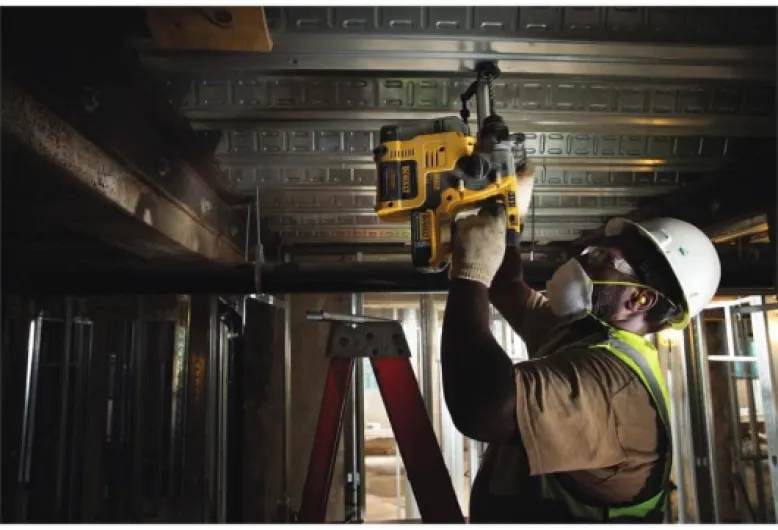
Balance-wise, with a 5Ah battery, it’s actually not bad. When drilling horizontally into a wall, the weight helps keep the bit where you want it. Overhead, you definitely feel it after a while, but that’s just how these tools are. The SHOCKS vibration control does help a bit. Compared to a cheaper SDS without any damping, my hands felt less beat up after a day of drilling anchors into a block wall. It’s not magic, but it’s noticeable.
One thing I liked is the built-in adjustable hook. I clipped it on a ladder rung and on some temporary framing, and it held fine. It sounds minor, but when you’re moving around a job and climbing up and down, being able to hang the drill instead of setting it on the ground every time is actually useful. Overall, the design is practical and work-oriented: nothing fancy, but the controls are clear, and you don’t need a manual to figure it out.
Battery life and power: solid with 5Ah, less fun with small packs
Since this is sold as a bare tool, how it behaves depends a lot on what battery you stick on it. I ran it mostly with 5Ah 20V MAX packs and occasionally with an older 3Ah. On the 5Ah, I got through an entire afternoon drilling anchors (probably 40–50 holes in concrete plus some random holes in block) on a single charge, with a bit left. That’s with normal use, not leaning on the trigger nonstop. For weekend projects, one 5Ah battery is usually enough, two is comfortable.
With the 3Ah battery, you can feel the drop. It still has the same punch, but the runtime goes down a lot faster. On a job where I was probing for rocks and drilling into hard-packed sediment, I drained a 3Ah pack in maybe an hour of on-and-off use. The drill didn’t slow down much until the battery hit the last bar, but you end up swapping batteries more often, which gets annoying.
One thing to keep in mind: this tool really deserves bigger packs. It’s not like a compact drill where a 2Ah battery is fine. The hammer mechanism pulls decent current, especially in harder concrete. If you already have DEWALT 4Ah or 5Ah batteries from other tools, you’re in good shape. If you only have the little compact ones, expect frequent charging and shorter work sessions.
Noise and heat-wise, the motor doesn’t cook the battery as long as you give it a short break here and there. After a few long holes, the pack was warm but not crazy hot. Overall, on the battery side, I’d say it’s pretty efficient for what it does. Just budget realistically: for serious use, at least one 5Ah pack is basically mandatory, and two is ideal if you don’t want to stop and wait for charging.
Durability and build: feels tough, but not bulletproof
I’ve had the DCH273B for long enough to run it through concrete, block, sediment, and some light chipping, plus it’s been bounced around in the back of a truck a few times. So far, nothing has rattled loose, and there’s no weird play in the chuck or side handle. The German-engineered mechanism thing in the description is marketing speak, but in practice, the hammer action does feel tight and consistent, not sloppy.
The outer shell is the usual DEWALT plastic with rubber overmold in the right spots. It’s held up fine to dust, a couple of minor drops from waist height, and being shoved into a tool bag with other stuff. The vents do suck in concrete dust, so I make a point to blow it out with compressed air after heavy use. If you’re drilling overhead a lot, dust will cake around the front and controls, but that’s just life with rotary hammers.
The SDS chuck still locks bits in securely; I haven’t had a bit slip or pop out accidentally. The mode selector is still crisp and hasn’t gotten mushy or vague, which is something I’ve seen on cheaper tools after a while. The side handle threads haven’t stripped, and it still clamps tight without having to over-torque it. All small things, but they matter over time.
Could you kill this tool on a full-time commercial crew drilling all day, every day? Probably, or at least you’d wear it out faster than a heavier-duty rotary hammer. For a mix of DIY, maintenance work, and occasional pro jobs, it feels sturdy enough. And there’s a 3-year limited warranty if something critical fails. I’d call the durability solid for its size and class, as long as you’re not abusing it like a demo hammer.
Performance in concrete and masonry: what it actually does on the job
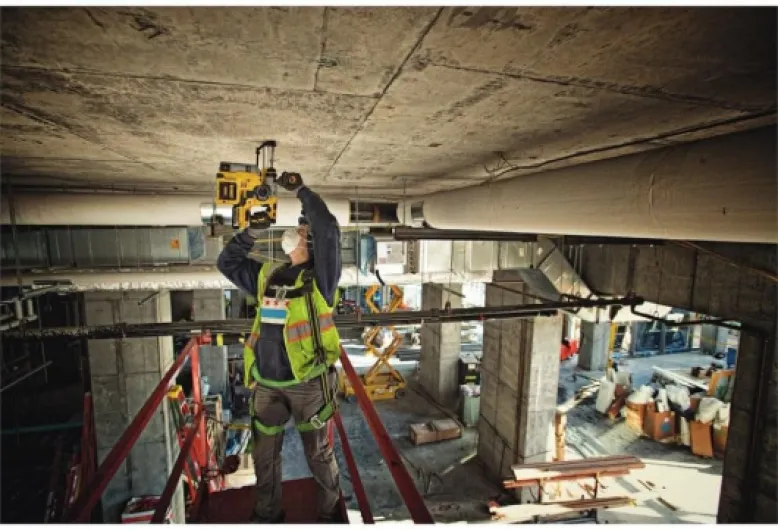
This is where the tool either earns its place or ends up on the shelf. In hammer drill mode, the DCH273B goes through concrete way faster than any standard hammer drill I own. I used it to drill around 30 holes for 3/8" wedge anchors in a cured garage slab and foundation wall. With a decent SDS bit, each hole took maybe 5–10 seconds. My old 18V hammer drill would take three times longer and heat up like crazy.
I also pushed it a bit with larger holes. I drilled a couple of 1" holes through a 10–12" poured concrete wall for running conduit. It took more time and I had to back the bit out a few times to clear dust, but it still got through both sides without stalling or tripping the battery. You can feel it working harder, and I wouldn’t want to do that nonstop all day, but for occasional bigger holes, it’s fine.
In chip mode, I used a small chisel to clean up some rough spots and knock off a lip of concrete near a doorway. It’s not a demolition hammer, so don’t expect it to break up a thick slab quickly, but for light chipping, removing thin high spots, or chasing out small channels, it’s perfectly usable. The blows feel controlled, not wild, which is nice when you’re working near finished surfaces.
Compared to corded SDS tools I’ve tried, I’d say this lands in the medium range. It’s not as strong as a big Hilti or Bosch SDS-Max, obviously, but for typical home and light commercial anchor work, it’s right where it needs to be. The main thing is consistency: it keeps a steady pace without bogging down as long as your bit is sharp and you’re not leaning on it like a maniac. For most people doing anchors, Tapcons, and occasional chipping, the performance is solid and feels like a proper rotary hammer, not a pretend one.
What you actually get with the DCH273B (and what you don’t)
The DCH273B is sold as a bare tool, which means in the box you’re getting the rotary hammer itself, a 360° side handle, a depth rod, and a belt/railing hook. That’s it. No battery, no charger, no bits, no case. If you already live in the DEWALT 20V ecosystem, that’s fine. If not, you need to factor in at least one 4Ah or 5Ah battery and a charger, otherwise this thing is just a yellow paperweight.
Spec-wise, it’s a 1" SDS-Plus rotary hammer, 20V brushless motor, with three modes on the dial: drill only, hammer drill, and chip (rotation stop). Impact energy is rated at 2.1 Joules, and the speed tops out around 1,100 RPM. That’s enough for typical anchor sizes and light chiseling, not for breaking up a whole driveway. There’s also DEWALT’s SHOCKS active vibration control built in, which basically means the handle has some isolation so your hands don’t buzz as much.
DEWALT also mentions OSHA Table 1 compliance when paired with the DWH303DH onboard extractor. I didn’t buy that dust attachment, so I can’t comment on it directly, but just know the drill is set up for that system if you work in environments where dust rules matter. For home use, I just used a helper with a shop vac or held the vac hose near the hole, which was good enough.
To sum it up, in terms of what you’re buying: it’s a compact SDS-Plus cordless rotary hammer aimed at anchors, small to medium holes, and light chiseling. Not a demolition hammer, not a full replacement for a big corded Hilti on huge jobs, but a very practical step up from a regular hammer drill. Just don’t forget the extra cost of batteries and bits, because those add up fast if you’re starting from zero.
Pros
- Drills anchors and medium holes in concrete much faster than a standard hammer drill
- Cordless design with decent runtime on 5Ah batteries, very handy on ladders and around the house
- Three modes (drill, hammer drill, chip) make it versatile for anchors, light chiseling, and general work
Cons
- Sold as bare tool only, real cost climbs if you don’t already own DEWALT 20V batteries
- Not ideal for heavy demolition or very large holes all day long
- Smaller batteries (2–3Ah) run out fast, practically needs 4–5Ah packs for comfortable use
Conclusion
Editor's rating
After actually using the DEWALT DCH273B on real jobs, my honest view is that it’s a pretty solid cordless rotary hammer for anchors, medium holes, and light chiseling. It drills concrete much faster and with less drama than a standard hammer drill, and the cordless aspect is genuinely useful when you’re working around a house, on ladders, or in areas with limited outlets. The vibration control and overall balance make it fairly comfortable for a tool that’s literally smashing concrete in front of you.
It’s not the right pick for everyone, though. If you’re a heavy commercial user drilling large holes all day or doing serious demolition, you’ll outgrow this and should look at a bigger SDS-Max or a heavier-duty corded unit. If you only need to drill a few holes once in a while and don’t own any DEWALT 20V batteries, a cheaper corded SDS or even renting one might be smarter. Where this drill makes the most sense is for people already in the DEWALT 20V system who regularly deal with concrete: DIYers with ongoing projects, maintenance techs, small contractors, or anyone tired of frying regular hammer drills on concrete jobs.
So, if you’re looking for a cordless rotary hammer that’s strong enough for most everyday concrete work, not insanely heavy, and fits into an existing DEWALT setup, this one gets the job done and feels reliable. Just go in knowing it’s bare tool only, budget for a 4–5Ah battery, and don’t expect it to replace a full-blown demolition hammer.