Summary
Editor's rating
Value for money: where it makes sense and where it doesn’t
Design and ergonomics: a bit rough, but practical
Battery compatibility and runtime with Makita packs
Comfort, noise and vibration in real use
Build quality and how long it might last
Performance on concrete, brick, metal and wood
What you actually get in the box
Pros
- Compatible with Makita 18V batteries, no issues with genuine packs
- Good drilling performance for 6–10 mm holes in brick, block and lighter concrete
- Brushless motor with decent runtime and manageable vibration for the price
Cons
- Bare tool only: no battery, no charger, and accessories are low quality
- Build quality and long-term durability are clearly below big-name brands
- Instructions are poor, especially for changing between SDS and standard chuck

Specifications
View full product page →| Brand | LIROPAU |
A cheap SDS that runs on your Makita batteries
I grabbed this LIROPAU 18V cordless hammer drill mainly because it’s compatible with Makita 18V batteries and I didn’t feel like paying Makita prices for a tool I’d only use occasionally. I’ve used it on a few small jobs: drilling into brick and block for fixings, a couple of holes through concrete, and some basic metal/wood drilling with the standard chuck. So this is not lab testing, just real life home and light trade use.
The first thing to know: this is a bare tool. No battery, no charger. If you don’t already have Makita 18V packs, skip it straight away. If you do, then it becomes an interesting budget option. I’ve mostly run it with a 5.0Ah and a 6.0Ah battery, the slide-on type you’d use with a Makita impact driver or combi drill.
On paper you get 2.2J impact energy, 1,400 rpm and 4,200 bpm, so it’s clearly aimed at DIY and light professional use, not heavy demolition. In practice it behaves exactly like that: it gets the job done on typical wall plugs and pipe runs, but it’s not the tool you’d pick to chase out walls all day. If you try to treat it like a high-end SDS, you’ll be disappointed.
Overall, my feeling after a few weeks is pretty simple: if you go in expecting a cheap cordless SDS that works with your Makita batteries, you’ll probably be happy. If you expect Makita build quality and lifespan for this price, you’re dreaming. It’s usable, it’s rough around the edges, and the accessories are basically a bonus, not the main reason to buy it.
Value for money: where it makes sense and where it doesn’t
On the value side, this drill sits in an interesting spot. It’s clearly cheaper than a genuine Makita cordless SDS, especially if you’re only buying the bare tool. If you already own a couple of Makita 18V batteries, it becomes a relatively low-cost way to add an SDS hammer to your setup. For occasional DIY, landlords, or trades who only need SDS from time to time (plumbers, electricians doing light fixings), it’s a pretty good deal.
The catch is that the accessories are basic. The bits are okay for a start, the gloves are almost throwaway, and there’s no case. So if you compare the price including the cost of buying decent bits and maybe a bag or case, the gap with better-known brands narrows a bit. Still, you’re paying less mainly because you’re not getting the brand name or the same warranty and long-term support.
Where it really doesn’t make sense is if you don’t own Makita batteries. Buying third-party batteries and a charger just for this drill will quickly eat up the savings, and you’ll still end up with a no-name tool and no real ecosystem. At that point, I’d rather buy a full kit from a mid-range brand that includes everything and has better after-sales support.
For me personally, as someone who already had Makita batteries and just needed a cordless SDS for smaller jobs, the value is pretty solid. I accept that it might not last forever, but at the price I paid, if it gives me a couple of years of light use, I’ll consider it money well spent. If you’re hard on your tools or rely on them to earn your living every day, I’d say spend more and get something tougher.
Design and ergonomics: a bit rough, but practical
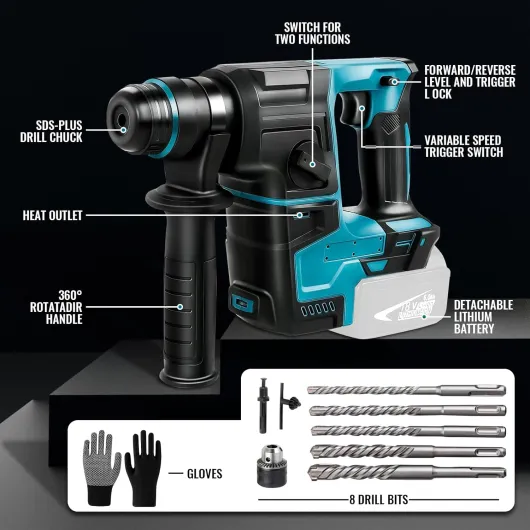
Design-wise, the LIROPAU goes for the classic teal/turquoise look that obviously reminds you of Makita, but once you hold it you can tell it’s not the same league. The plastics feel a bit harder and cheaper, and some of the moulding lines are visible. That said, the overall shape and balance aren’t bad at all, especially once you stick a 5Ah or 6Ah battery on it. The weight with a big battery lands in the usual SDS cordless range; not feather-light, but manageable for overhead work in short bursts.
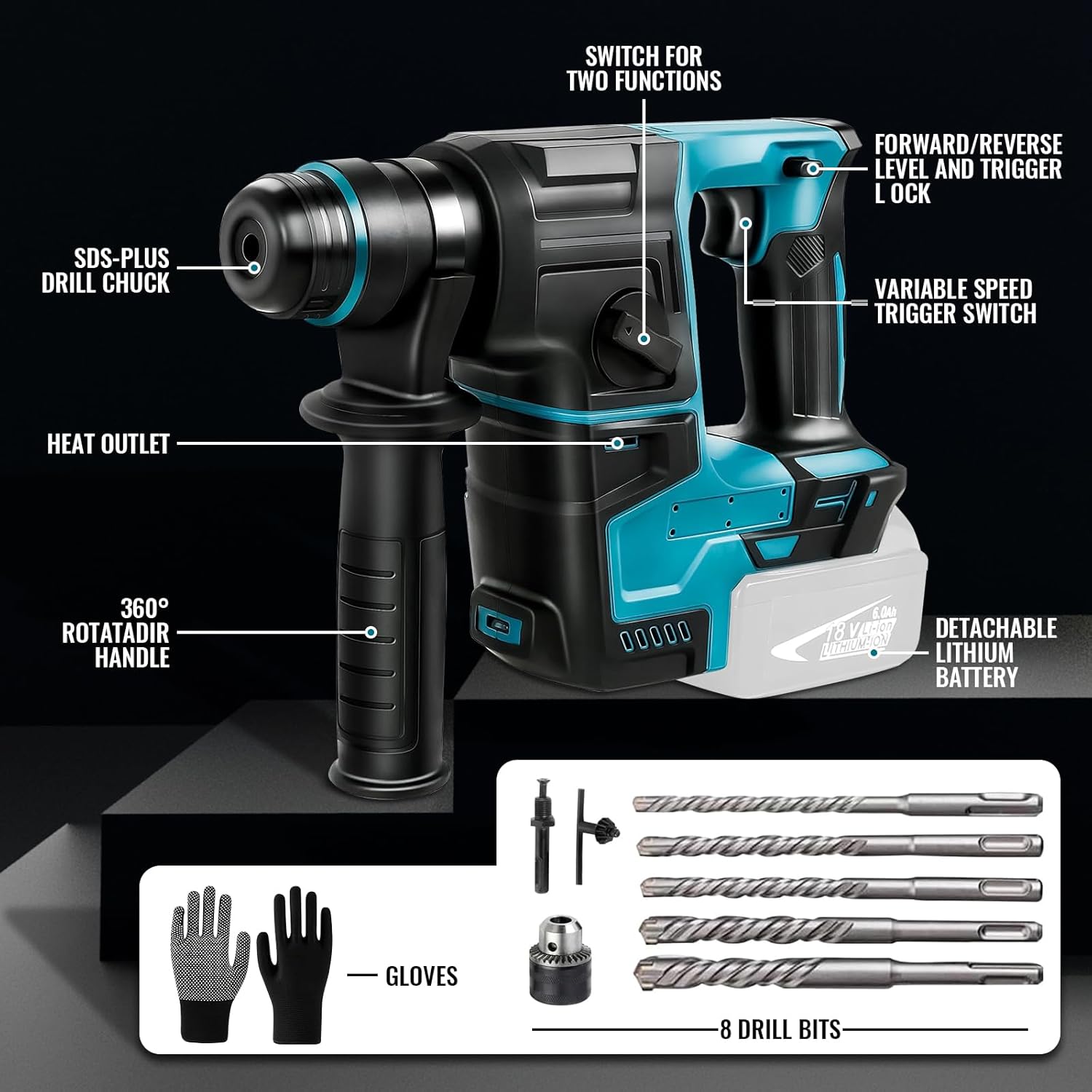
The 360° adjustable handle is actually useful. You can rotate it to get a better grip when drilling into walls at awkward angles, and it tightens down reasonably well. It’s not as solid-feeling as a premium brand, but it didn’t slip on me while drilling 10–12 mm holes in brick and block. The main trigger has decent modulation, so you can start slow and ramp up. There’s a simple mode selector: drill with hammer / drill only. No fancy extra modes like chisel-only, so if you’re hoping to use it as a mini breaker, forget it.
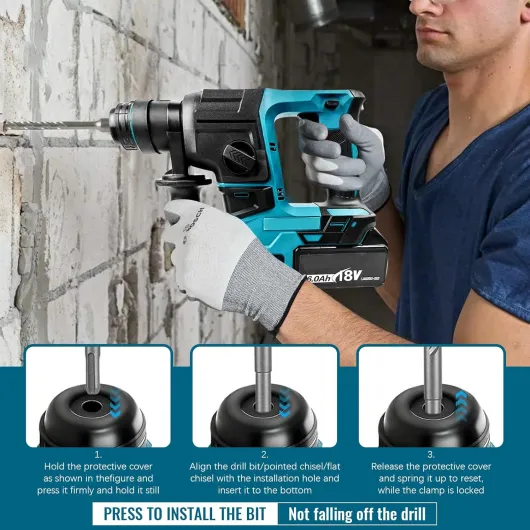
One thing that’s a bit annoying is the chuck change system. You get an SDS-plus quick-change chuck and a standard keyed chuck with an adapter. The idea is good, but the manual barely explains how to swap them. I had to look up a video to be sure I wasn’t forcing something. Once you understand it, it’s straightforward, but for a first-time user it’s not very intuitive. This matches what another buyer mentioned: the tool is fine, the documentation is weak.
On the whole, the design is pretty functional. It’s not pretty, it’s not especially compact, but it’s laid out in a way that makes sense. All the key controls are where you expect them, the battery slides in and out cleanly, and the SDS collar works like any other SDS-plus drill. I’d call the design “no-frills but usable”. If you’ve used other budget SDS drills before, you’ll feel at home quickly.
Battery compatibility and runtime with Makita packs
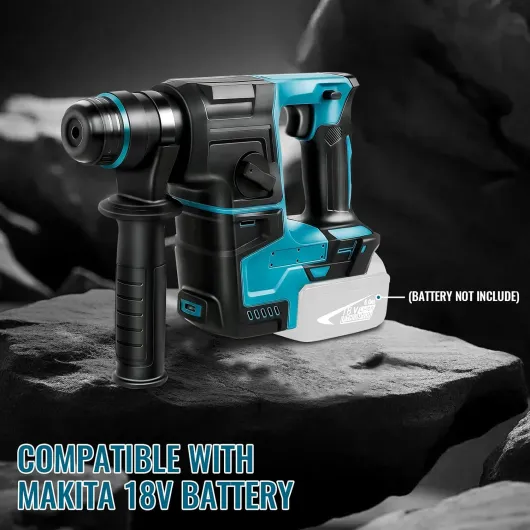
The big selling point of this drill is compatibility with Makita 18V lithium-ion batteries. I tried it with a genuine Makita 5.0Ah, a 6.0Ah and a third-party 4.0Ah pack. All three locked in securely, no wobble, no random cut-outs. The contacts line up well and I didn’t get any overheating warnings from the batteries, which I sometimes see on cheap tools with poor connections.
In terms of runtime, with a 5.0Ah battery I managed a small bathroom job: drilling roughly 20–25 holes (6 and 8 mm) in brick and block, plus a few 10 mm holes for pipe clips, and the battery still had charge left. With a 6.0Ah pack, I did around 30–40 holes spread over a couple of days before recharging. That lines up with what one plumber mentioned: the motor seems fairly efficient and doesn’t get hot quickly, which usually means better battery life.
Of course, there’s no battery gauge on the tool itself, so you rely on whatever is on your Makita battery. There’s also no fancy electronics or app or anything like that, which I don’t miss at all on a budget drill. You pull the trigger, it runs. When the battery is low, you feel the power drop, just like on any other cordless tool.
The main thing to remember: if you don’t own Makita batteries already, this tool makes little sense. Buying compatible batteries and a charger separately will push you close to the price of a proper Makita or another established brand kit. But if you already have a few Makita 18V packs lying around, this LIROPAU becomes a cheap way to add an SDS drill to your lineup without spending a lot.
Comfort, noise and vibration in real use
In terms of comfort, I went in with low expectations and was actually a bit surprised. The drill has a soft grip on the handle that does help with slipping, especially when your hands are a bit dusty or sweaty. It’s not as cushioned as higher-end tools, but it’s enough that you don’t feel like you’re holding raw plastic. The weight distribution with a 5–6Ah battery is decent; it doesn’t feel nose-heavy like some cheap SDS drills I’ve used.
The brand mentions an anti-vibration system. Let’s be honest: this is still a hammer drill, it vibrates. But compared to a very old corded SDS I have, this one is easier on the hands. When drilling 6–8 mm holes for wall plugs in brick, I didn’t feel wrecked afterwards. On 12–14 mm holes in harder block, you do feel it in your wrists after a while, but nothing shocking. For occasional DIY and light trade jobs, the comfort level is perfectly acceptable.
Noise-wise, it’s fairly loud, especially in hammer mode. One plumber’s review mentioned this too. It’s not absurd, but this is not something you’ll want to use late at night in an echoey stairwell. Ear protection is a good idea if you’re drilling continuously. The motor sound itself is quite sharp, which gives a sense of power but also adds to the fatigue if you’re using it for a long session.
The included gloves are exactly what I expected: thin, basic, better than nothing but not great. I used them once, then switched back to my usual work gloves because they fit better and protect more. So in terms of comfort, I’d say: for short to medium jobs it’s fine, for full-day use you’ll want better hearing protection and maybe a more refined tool. For the price point though, the comfort is decent and the vibration is manageable.
Build quality and how long it might last
Durability is where you clearly see this is a budget tool. The housing is all plastic with some rubber overmould, and while it doesn’t feel like a toy, it also doesn’t give that “I’ll survive a fall off the scaffold” vibe. I haven’t dropped mine yet, but just handling it, I’d be careful not to abuse it too much. The side handle clamp and mode selector both feel okay, but not rock-solid.
After a few weeks of light to moderate use, there’s no obvious play in the chuck, no weird noises, and the motor still runs smoothly. The brushless motor is a good sign long-term, as there are no brushes to wear. However, some Amazon reviews mention the hammer function starting to fail after around five months. That doesn’t shock me for a no-name brand tool at this price. If you hammer it (literally) every day, you’re likely to find the weak points sooner.
The included drill bits are clearly consumables. The smaller ones are fine for a handful of holes, but they dull quicker than decent brand bits. If you plan to keep the drill for a while, just buy a proper SDS-plus set from a known brand and save yourself the frustration. Same for the gloves: they’ll probably tear after a bit of real work.
My feeling is: if you’re a DIYer or light trade and you use this once in a while, it should last a reasonable amount of time as long as you don’t regularly push it to the limit. If you’re a daily tradesperson drilling all day, I wouldn’t expect years of service. For that, you’d need to invest in a more expensive brand. So durability is acceptable for the price, but not a strong point.
Performance on concrete, brick, metal and wood
This is the part that matters: does it actually drill properly? In hammer mode, it’s honestly pretty solid for what it is. The 2.2J impact rating feels believable. I’ve drilled multiple 6 and 8 mm holes into standard brick and concrete blocks for wall plugs, pipe clips and brackets. It goes through at a reasonable pace, not lightning fast but definitely not struggling. Compared to my old corded SDS, it’s maybe a bit slower, but the freedom of no cable compensates for that.
With bigger bits (10–12 mm) in medium block, it still gets the job done, but you can feel it working harder. One plumber who reviewed it said he “doesn’t want to wear it out” on big bits, and I get that. It can do it, but this is not the drill you’d use all day with 16 mm bits in hard concrete. If you stay in the 6–10 mm range for most tasks, it’s in its comfort zone. For occasional larger holes, it’s okay, just don’t expect miracles.
In drill-only mode with the standard chuck, it handles wood and metal like a mid-range cordless drill. I ran a few 6–8 mm holes in mild steel and some 10 mm holes in timber. The speed control is decent at low rpm, so you can start a hole cleanly in metal without skidding everywhere. It’s not as refined as a dedicated combi drill, but if you just need one tool on a small job, it’s handy to have both functions.
There is one downside: some users reported the hammer function failing after a few months. I haven’t had that issue yet, but it’s something to keep in mind. This is where you see the price difference compared to big brands. If you’re a heavy user, I wouldn’t rely on this as your only SDS. For occasional use, the performance is good enough, and for light trade like a plumber doing 5–7 mm holes in brick and stone, it seems to cope just fine according to reviews and my own use.
What you actually get in the box
Out of the box, the LIROPAU kit is fairly straightforward. You get the cordless hammer drill body, a side handle that rotates 360°, a depth stop, a basic pair of gloves, and a small set of SDS-plus drill bits (5 bits: 6, 8, 10, 12, 14 mm). You also get a classic keyed chuck with an adapter so you can use non-SDS bits, plus the little chuck key. There’s a user manual, but honestly, it’s not very helpful beyond the basic safety icons.
The whole thing arrives in fairly standard packaging, no fancy case. Mine came in a cardboard box with foam inserts. The drill wasn’t damaged, but it doesn’t feel like something you’d throw in and out of a van every day without eventually bashing it up. The included bits are clearly entry-level quality. They’re fine if you’re drilling the odd hole in brick or light concrete, but I wouldn’t rely on them for regular professional use. I switched to my own SDS bits pretty quickly.
Important point: no battery, no charger. The listing says it clearly, but it’s easy to miss if you skim. It’s designed to work with Makita 18V lithium-ion batteries. I tried with a genuine Makita 5.0Ah and a third-party 4.0Ah compatible battery. Both clipped in fine and the tool ran without any weird behaviour. So if you already have a Makita ecosystem, it slots in nicely.
In terms of first impression, it feels like a budget SDS that tries to tick all the boxes: brushless motor, two modes, SDS chuck plus standard chuck, side handle, some bits and gloves. Nothing feels premium, but nothing felt unusable right out of the box either. My honest view: buy it for the tool, treat everything else as freebies. That matches what at least one Amazon reviewer said, and I agree after using it.
Pros
- Compatible with Makita 18V batteries, no issues with genuine packs
- Good drilling performance for 6–10 mm holes in brick, block and lighter concrete
- Brushless motor with decent runtime and manageable vibration for the price
Cons
- Bare tool only: no battery, no charger, and accessories are low quality
- Build quality and long-term durability are clearly below big-name brands
- Instructions are poor, especially for changing between SDS and standard chuck
Conclusion
Editor's rating
Overall, the LIROPAU 18V cordless hammer drill is a decent budget option if you already own Makita 18V batteries and you just need an SDS for occasional or light trade use. It drills brick, block and lighter concrete without drama, handles typical 6–10 mm fixing holes well, and can manage bigger bits if you don’t push it all day. The brushless motor, acceptable vibration, and reasonable balance make it quite usable in real life, not just on paper.
On the downside, it’s clearly built to a price. The plastics feel cheaper, the accessories are basic, and there are a few reports of the hammer function failing after several months. The instructions are poor, especially around changing chucks, and there’s no case. If you’re a heavy user or want something that’ll survive years of daily abuse, this is not the tool for you. In that case, go for Makita or another established brand, pay more, and get the durability and support.
I’d recommend this drill to DIYers, landlords, and light trades who already run on Makita 18V and want a low-cost SDS beater for drilling into walls, setting fixings, and doing small jobs where dragging a corded drill is annoying. If you’re starting from zero with no batteries, or you depend on your tools every day on site, skip it and invest in something tougher with a better track record.