Summary
Editor's rating
Value for money: where this Ingco kit really makes sense
Design and ergonomics: not premium, but pretty well thought out
Battery and charger: okay for DIY, a bit light for full-day work
Durability and build: solid enough, with a few budget vibes
Performance: plenty of punch for DIY, and not just for show
What you actually get in the Ingco CKLI20277 box
Pros
- Strong performance for DIY: 285 Nm impact driver and 66 Nm drill handle most home and light trade tasks
- Both tools use brushless motors, which should mean better efficiency and lower wear
- Good value bundle with 2 batteries, fast charger, and a hard case included
Cons
- 2.0 Ah batteries are a bit limited for long or intensive work sessions
- Case and included accessories feel basic and slightly cramped
- Finish and long-term toughness likely below top professional brands

Specifications
View full product page →| Brand | Ingco |
Two weeks with the Ingco twin pack: here’s the blunt truth
I’ve been using this Ingco 20V brushless twin pack (impact driver 285 Nm + impact drill 66 Nm) for a couple of weeks on real jobs, not just drilling into a bit of scrap wood. I put it through small DIY tasks at home, some furniture assembly, a few wall fixings, and a small decking repair in the garden. In short: I didn’t baby it. I bought it as a “beater kit” to avoid dragging my more expensive tools everywhere, and I wanted to see if a mid‑price Chinese brand like Ingco actually holds up in normal day-to-day use.
First impression when I opened the case: it looks serious enough. Yellow and black, quite similar vibe to DeWalt from a distance, but once in hand you can tell it’s not at the same premium level. That said, it doesn’t feel like a cheap toy either. Both tools are brushless, which is already a good point at this price, and you get two 2.0 Ah batteries plus a fast charger. For a home user or casual tradesperson, that’s basically everything you need to start.
During these two weeks, I mainly used the impact drill for drilling into wood, masonry plugs in brick, and basic screwdriving. The impact driver did the heavy screw work: decking screws, coach screws into posts, and some stubborn old screws in a door frame. I also tested how the batteries behaved: full charge, partial charge, and leaving one sitting for a few days. I wanted to see if there was any annoying power drop or if the tools overheated too fast.
Overall, my feeling is pretty simple: the kit is good value for money and strong enough for most DIY users and light professional use. It’s not perfect: the accessories are basic, the case is a bit cramped, and the 2.0 Ah batteries are on the small side if you plan to work all day. But if you’re looking for something that gets the job done without paying big-brand prices, this combo makes sense. I’ll go through design, performance, battery, durability, and value so you know exactly what you’re getting into.
Value for money: where this Ingco kit really makes sense
In terms of value, this is where the Ingco twin pack is pretty strong. You’re getting two brushless 20V tools, two batteries, a fast charger, and a case for a price that’s usually lower than a single pro-brand brushless drill with one battery. If you’re a DIY user or a starting tradesperson on a tight budget, that matters. The performance is more than enough for typical jobs: hanging shelves, building a shed, working on decking, or doing light automotive work like removing smaller bolts with the impact driver.
Now, compared to big names like DeWalt, Makita, or Bosch Pro, you do feel a difference in finish, accessory quality, and probably long-term toughness. The plastic feels a bit cheaper, the case is basic, and the bundled bits are serviceable but nothing special. If you work on site every day and your tools live a hard life, I’d still lean towards a premium brand just for peace of mind and better long-term support. But that’s also a much bigger investment.
For someone like me who already has a higher-end kit and just wanted a second set to leave in the car or use for “dirty” jobs, this Ingco pack makes a lot of sense. It’s strong enough that I don’t feel like I’m using a toy, and cheap enough that I’m not stressed if it gets dented or stolen. For a homeowner buying their first cordless kit, it’s also a good deal: you get impact driver + drill + batteries in one purchase, and you can grow the system later with other P20S tools.
So overall, I’d say the value for money is good to very good for its target: serious DIYers and budget-conscious pros. It’s not the cheapest thing out there, but considering the brushless motors, the torque levels, and the complete package, you’re getting a solid amount of tool for the money. Just go in knowing it’s a mid-range kit, not a top-tier professional setup, and you’ll probably be pretty happy with what you get.

Design and ergonomics: not premium, but pretty well thought out
Design-wise, both tools follow the usual modern cordless layout: pistol grip, rubber overmold, and a short-ish body. The yellow and black colour scheme is clearly aiming at the DeWalt crowd, but when you hold them you feel a slight difference: the plastic is a bit more “hard” and the rubber overmold feels thinner. Still, nothing wobbles, no odd creaks when you squeeze the handles, and the switches feel decent. The forward/reverse selector clicks firmly into place and didn’t slip once during my tests.
The impact drill has a standard 13 mm metal chuck that tightens by hand. It locks well enough; I didn’t have bits slipping during drilling in wood or brick. The mode ring (torque, drill, hammer) and the torque collar turn with a bit of resistance, which I actually like because it doesn’t move by accident. The two-speed switch on top is easy to reach with your thumb and feels fairly solid. The only thing I noticed is that the drill is slightly nose-heavy with the 2.0 Ah battery, but not to the point of being annoying.
The impact driver is more compact, which is good for working between joists or in cabinets. The bit holder is the usual quick-change hex chuck. Bits snap in and out without drama. The three‑speed selector is a simple button, and the LED indicator for the speed is small but visible. The LED work light is placed under the chuck; it’s not a floodlight, but in a dim hallway or under a worktop it’s enough to see what you’re doing. I did notice that it stays on for a short time after you release the trigger, which is handy.
Ergonomically, both handles are comfortable enough. I have medium-sized hands, and I could use them for an hour straight without hand fatigue. Someone with bigger hands might find the grip a bit slim, but that’s subjective. There’s no side handle for the drill, which you do feel when drilling into hard masonry with the hammer function; you have to hold it firmly. In short, the design is practical: not fancy, not ultra-compact, but well-balanced and easy to handle for typical DIY tasks. For the price, I don’t have major complaints about the design.
Battery and charger: okay for DIY, a bit light for full-day work
Battery-wise, you get two 20V 2.0 Ah lithium packs. For a DIY user, that’s usually enough, but you have to be realistic: 2.0 Ah is not huge. With the impact drill doing mixed tasks (drilling a few dozen holes in wood and brick, plus some screwdriving), I got roughly 45–60 minutes of active work per battery. With the impact driver, driving long screws non-stop drains the battery faster. On a decking repair job, one pack lasted me roughly 30–40 minutes of pretty continuous screwdriving. For occasional use around the house, this is fine. For a full day on site, you’d want at least one extra battery or higher capacity packs.
The charger is advertised as a quick charger with about one-hour charge time, and that matches what I saw. From nearly empty to full took me just under an hour most of the time. The charger is not huge, it’s fairly light, and it doesn’t sound like a hairdryer when it runs, which is nice. It has basic indicator lights to show charging and full, nothing fancy. The cooling seems decent; the batteries were warm after heavy use but not hot, and the charger didn’t overheat during back-to-back charges.
The batteries have a simple charge indicator on them. Press a button, and a few LEDs show the level. It’s not ultra-precise, but it’s enough to know if you can start a job or if you should swap packs before going up a ladder. I left one battery unused for about a week and there was no noticeable self-discharge; it still showed a nearly full charge and behaved normally when I used it.
One good point is the compatibility with the Ingco P20S platform. If you decide to buy their saw, grinder, or other tools later, you can reuse these batteries and charger. On the downside, if you already own batteries from another big brand, they’re obviously not compatible, so you’re locked into Ingco’s ecosystem. Overall, the battery setup is decent for home and occasional pro use: fast enough charging, okay runtime, but not ideal for heavy all-day work unless you invest in more or larger batteries.
Durability and build: solid enough, with a few budget vibes
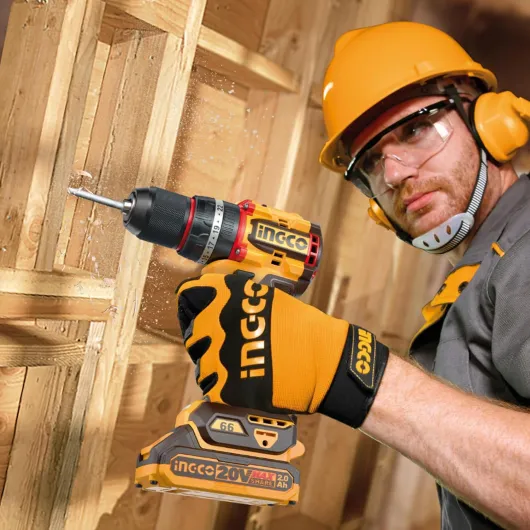
On durability, I obviously can’t simulate years of use in a couple of weeks, but I can talk about how it feels and what I noticed. Both tools use a mix of hard plastic housing with rubber overmold on the grip and key contact areas. The brushless motors are a plus: less wear, less heat, and in theory a longer life than brushed motors. During my tests, neither tool overheated, even after several battery cycles of fairly hard use on screws and drilling. The ventilation slots are quite large, which helps cooling but also means dust can get in, so it’s worth blowing them out with compressed air from time to time if you use them on dusty jobs.
I did a couple of unplanned “tests”: I dropped the impact driver once from about waist height onto a wooden floor, and it just got a small scuff on the plastic, no cracks, no functional issue. The chuck and speed selector still worked perfectly. The drill got a few knocks against brick when drilling, again just normal scratches. The metal chuck on the drill is reassuring; it feels stronger than the plastic chucks you sometimes see on cheaper drills, and it held bits securely over multiple uses.
The case is where you feel the budget side a bit more. It’s a hard plastic case that closes fine, but the internal layout is a bit cramped. Once you put both tools, charger, two batteries, and all the bits in, you end up playing Tetris to close it neatly. The plastic of the case is okay but not heavy-duty; if you sit on it or throw it around a van every day, I don’t think it will last forever. For home storage and occasional transport, it’s fine.
Overall, my impression is that the tools themselves feel robust enough for regular DIY and light trade use. The materials are not top-tier pro level, but there’s nothing obviously flimsy or badly finished. If you’re a full-time tradesperson using these every single day, I’d expect some wear on the switches and chuck sooner than on a premium brand. But for weekend jobs, house renovations, and occasional site work, the durability seems acceptable for the price. Just don’t treat them like indestructible site tools and you should be okay.
Performance: plenty of punch for DIY, and not just for show
On the performance side, both tools did better than I expected for this price range. Let’s start with the impact driver (285 Nm). I used it on 120 mm decking screws going into treated joists and posts. It drove them in without pre-drilling in most cases, only struggling a bit when I hit knots in old timber. On the highest setting, it has more than enough torque to bury the screw heads into the wood if you’re not careful. On lower power settings, it’s easier to control and less likely to strip screw heads. I also used it to remove some old rusted screws from a gate; it handled them fine once I let the impacts work for a few seconds.
The impact drill (66 Nm) is more of an all-rounder. In wood, it drills 6–10 mm holes with no effort, and even 13 mm holes are fine as long as your bit is sharp. For masonry, I tested it with 6 and 8 mm bits in standard brick walls. With the hammer mode on, it went through brick reasonably fast. It’s not in the same league as a proper SDS drill, but for putting up shelves, curtain rails, or wall plugs in a house, it does the job. The two-speed gearbox is useful: low gear for more torque when screwdriving, high gear for drilling.
One thing I liked is the trigger control. Both tools have variable speed that reacts quite smoothly to how much you squeeze the trigger. That’s especially useful with the drill when you’re starting a hole or driving smaller screws; you can go slow at the beginning and then speed up. The hammer mode on the drill is a bit noisy and you feel more vibration, but that’s normal. The driver’s impact noise is loud too (like any impact driver), so if you’re working indoors for a while, ear protection is not a bad idea.
In practice, across a couple of small projects (fitting a TV bracket, assembling flat-pack furniture, fixing deck boards, and some repairs on a fence), I never felt the tools were too weak. The only time I felt the limit was drilling several larger holes in hard masonry, where an SDS drill is still clearly better. For DIY and light trade tasks, though, the performance is more than enough. If you’re a full-time carpenter or builder, you’ll probably still prefer a top-brand kit, but for most people this has enough power and speed to handle day-to-day jobs without frustration.
What you actually get in the Ingco CKLI20277 box
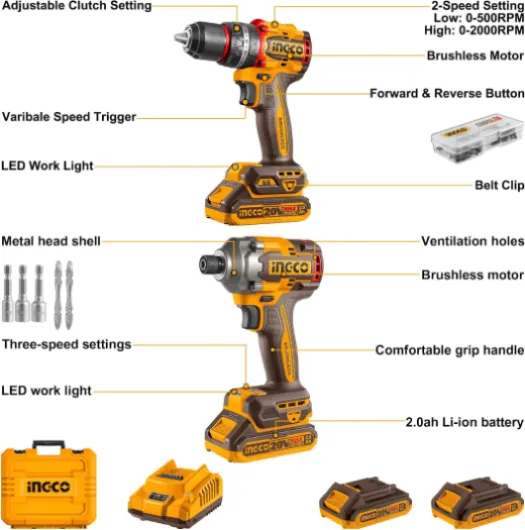
In the box you get a fairly complete starter kit. There’s one impact drill (66 Nm, 2 speeds, hammer function), one impact driver (up to 285 Nm), two 20V 2.0 Ah lithium batteries, one fast charger, a bunch of bits (screwdriver bits, some drill bits, three nut drivers), and a hard plastic carrying case. It’s basically a ready-to-go set for most home projects. You don’t have to buy batteries or chargers separately, which already saves a bit of hassle and money.
The impact drill has a 13 mm metal chuck, 2-speed gearbox (0–500 / 0–2000 rpm), and 22 torque settings plus drill and hammer modes. So you can use it as a normal drill, a screwdriver, or a light hammer drill for brick and block. The impact driver comes with three speed/impact settings (0–1600 / 1900 / 2600 rpm) and up to 285 Nm of torque, which is more than enough for long wood screws and most bolts you’ll meet on DIY jobs. Both tools have a built‑in LED work light and a standard forward/reverse switch.
The batteries are part of the Ingco P20S 20V platform, so if you buy other Ingco tools later, you can reuse them. The charger is a fast type: roughly one hour to charge a 2.0 Ah pack from empty, which I roughly confirmed in my tests (it was around 55–65 minutes depending on how drained the pack was). There’s also a basic battery level indicator on the packs, which is handy to check before you climb a ladder.
Overall, in terms of what’s included, it’s pretty solid:
- 2 cordless tools (driver + drill/hammer)
- 2 x 2.0 Ah batteries
- 1 fast charger
- 47-ish accessories (bits, nut drivers, etc.)
- 1 hard case
Pros
- Strong performance for DIY: 285 Nm impact driver and 66 Nm drill handle most home and light trade tasks
- Both tools use brushless motors, which should mean better efficiency and lower wear
- Good value bundle with 2 batteries, fast charger, and a hard case included
Cons
- 2.0 Ah batteries are a bit limited for long or intensive work sessions
- Case and included accessories feel basic and slightly cramped
- Finish and long-term toughness likely below top professional brands
Conclusion
Editor's rating
After using the Ingco CKLI20277 twin pack on several real jobs, my opinion is that it’s a solid mid-range kit that gives you a lot for the price. The impact driver has plenty of torque for decking screws and general fixing, and the impact drill handles wood and light masonry without drama. Both tools are brushless, which is rare at this price point, and they feel reasonably robust and well-balanced in the hand. The batteries and fast charger are good enough for home use and occasional site work, and the whole pack is fairly compact to store.
It’s not perfect. The 2.0 Ah batteries are a bit small if you plan to work all day, the case feels basic, and the accessories are nothing special. If you’re a full-time tradesperson who abuses tools daily, a premium brand will still be safer in the long run. But for most DIYers, homeowners, and even some budget-conscious pros, this kit gets the job done without costing a fortune. If you want one combo that covers drilling, screwdriving, and heavier fixing with decent power and you don’t care about flashy branding, this Ingco set is a sensible choice. If you need maximum durability, longer runtime, and top-tier ergonomics, you should look higher up the range and be ready to pay more.