Summary
Editor's rating
Good value if you know what you’re buying
Chunky, simple, and a bit front-heavy
Two 4.0Ah packs that actually last
Build feels decent, but this isn’t a pro shop workhorse
Torque in real life vs torque on the box
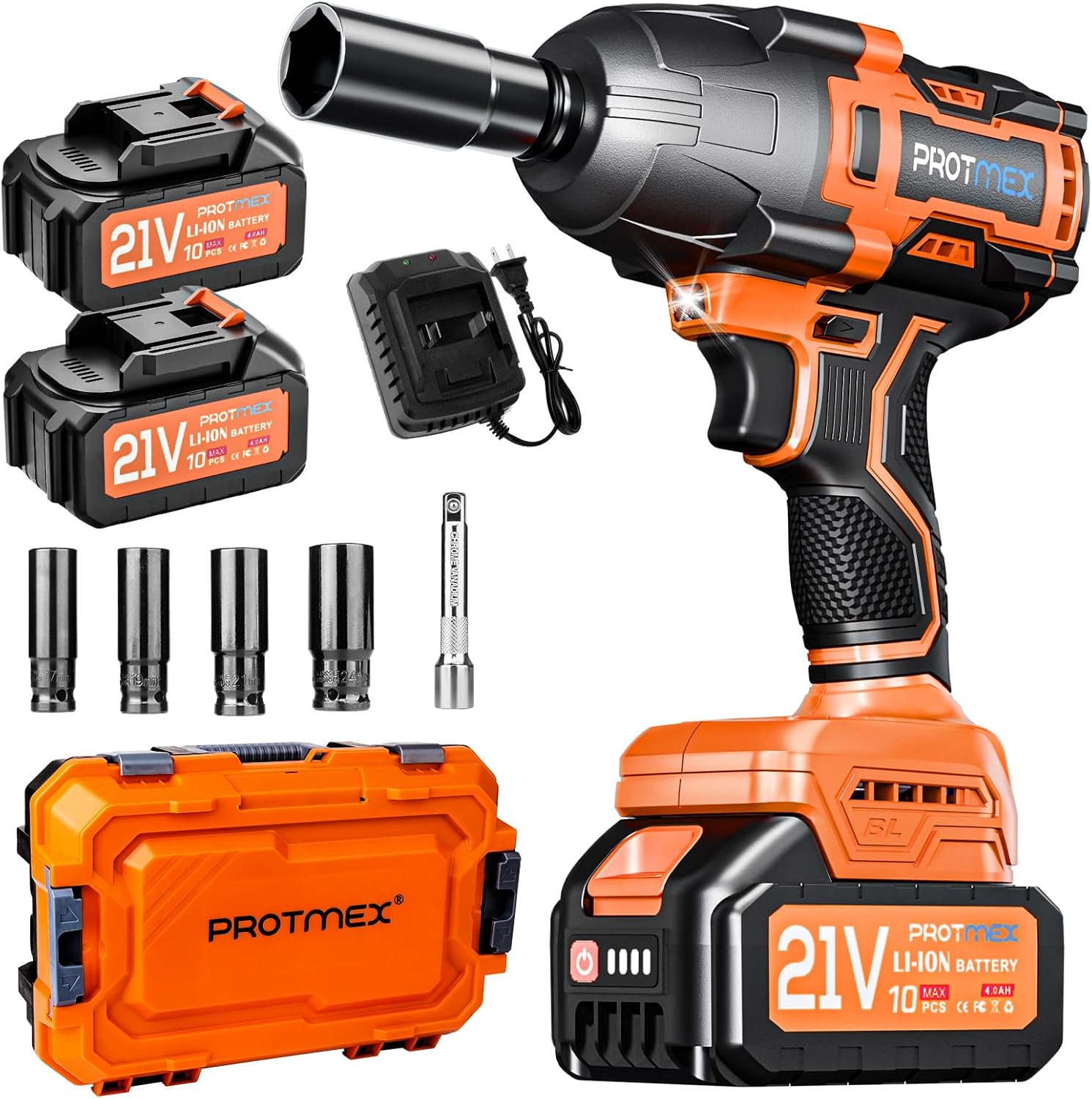
What you actually get in the kit
Pros
- Plenty of power for typical car lug nuts, brake jobs, and light suspension work
- Includes two 4.0Ah batteries with good runtime plus sockets and a case
- Simple controls with three forward speeds and a useful LED light
Cons
- Real-world torque is clearly lower than the advertised 900 ft-lbs
- Included sockets are basic and not ideal for heavy or daily use

Specifications
View full product page →| Brand | Protmex |
A cheap cordless impact that actually has some bite
I picked up this Protmex 21V impact mainly for tire swaps and the odd rusty bolt on my cars and mower. I didn’t want to spend Milwaukee or DeWalt money for something I’d use a few times a month, so this sat in the “good price, maybe too good?” category. After a couple weeks of real use on a Subaru, a VW Golf and a small trailer, I’ve got a pretty clear idea of what it does well and where it hits its limits.
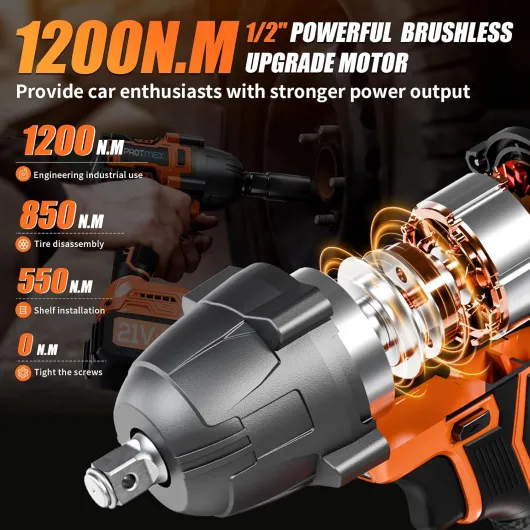
First thing: ignore the “900 ft-lbs / 1200 Nm” claim. That number is fantasy for a tool at this price. If you expect it to rip off semi-truck lug nuts that some shop hammered on with 1,200 ft-lbs, you’re going to be disappointed. But for normal passenger car wheels torqued in the 80–120 ft-lb range, it mostly gets the job done without drama. On my Subaru axle nut (properly torqued but not rusted solid) it broke it free without needing a breaker bar, which honestly surprised me for a no-name brand.
In day-to-day use, it feels like a decent mid-range impact, not a pro shop monster. It’s strong enough that I don’t bother with a hand wrench for most lug nuts anymore, but I still keep a breaker bar nearby for the really stubborn, rusty stuff. The included sockets are fine for casual use, though I wouldn’t trust them as my only set if you wrench every day.
Overall, it’s not perfect, but as a “garage weekend warrior” tool, it makes tire rotations, brake jobs, and simple suspension work faster and less annoying. If you go in with realistic expectations about the torque and don’t treat the marketing numbers as gospel, it’s a pretty solid cordless impact for the money.
Good value if you know what you’re buying
In terms of value for money, this Protmex sits in a nice spot. For the price of one bare-tool big-name impact, you’re getting a full kit: tool, two 4.0Ah batteries, charger, sockets, extension, and a case. If you’re a casual user who doesn’t already have a battery ecosystem (like DeWalt, Milwaukee, Makita, etc.), that’s a pretty strong package. You can literally open the box and start swapping tires.
The trade-off is obvious: you’re not getting the same refinement, raw torque, or brand support you’d get from those bigger names. The claimed “900 ft-lbs” is marketing talk, and the build isn’t on the same level as a $300+ pro impact. But for typical jobs – lug nuts, basic suspension work, mower blades, light tractor tires – it’s more than enough. If you compare it to other random Amazon specials, the dual 4.0Ah batteries and brushless motor make it stand out a bit.
Where the value drops is if you actually need heavy-duty performance every day. At that point, spending more on a known pro brand makes sense, because the extra torque, better durability, and easy parts/battery availability matter. For me, as a home user who mostly needs it a few times a month, the Protmex hits a sweet spot: cheap enough that I don’t stress about it, strong enough that I’m not constantly reaching for the breaker bar.
So in plain terms: if you’re doing your own tire rotations, seasonal swaps, and general DIY car work, the value is pretty solid. If you’re dreaming of ripping off semi-truck wheels or seized industrial bolts, you’re shopping in the wrong price range altogether.
Chunky, simple, and a bit front-heavy
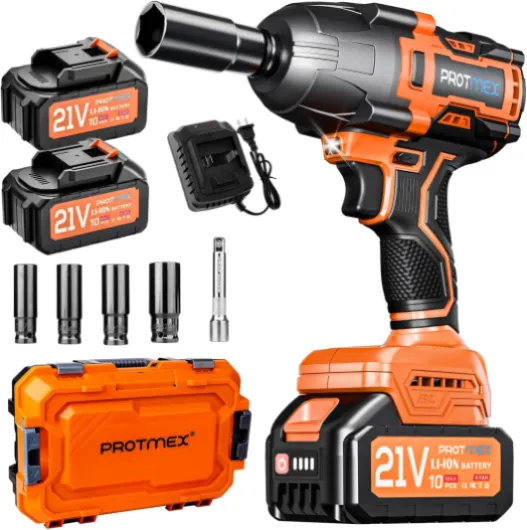
Design-wise, this thing is straightforward: orange and black plastic body, rubber overmold on the grip, and a fairly big brushless motor housing at the front. It’s not winning any beauty contests, but it looks and feels like a typical budget impact gun. The important part is how it handles in your hand, and there it’s decent. With the battery on, it’s definitely not light, but the weight is manageable for jobs like swapping four wheels or working under the car for an hour or so.
The balance is a bit front-heavy, which is normal for an impact but more noticeable here because the head is chunky. When you’re holding it straight out at arm’s length for a while, you feel it in your wrist. On the flip side, that weight helps keep it stable when it starts hammering. I didn’t feel like it was jumping around or trying to twist out of my hand, even on the highest speed setting. The rubberized grip has enough texture that it doesn’t feel slippery, even when your hands are a bit oily.
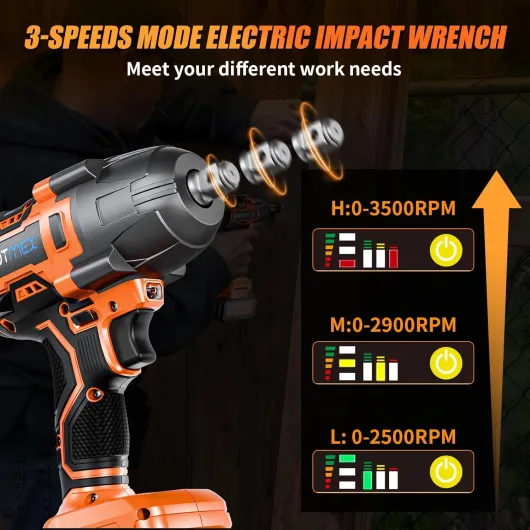
Controls are basic and that’s fine. There’s a forward/reverse/lock switch above the trigger and a separate button to change speed modes. The speed button cycles through three forward speeds, while reverse seems to be one fixed speed plus the brake-stop feature. The LED work light is under the head and points roughly where you need it. It’s not super bright, but under a car or in a dim garage, it helps enough that you don’t have to grab a separate flashlight for simple stuff.
One thing I liked: the anvil (the 1/2" square drive) has a detent pin, so sockets stay on but aren’t impossible to remove. Some cheap tools either drop sockets constantly or hold onto them like they’re welded on. This one is in the middle. Overall, the design feels thought-through enough for home and hobby use, even if it’s not as refined or compact as the big-name brands.
Two 4.0Ah packs that actually last
The batteries are one of the stronger points of this kit. You get two 21V 4.0Ah packs, which is more than a lot of budget impacts that only throw in a single small battery. In actual use, I was able to do multiple jobs on one charge. For example, I swapped four wheels on the Subaru, did a quick brake inspection (lots of on/off, spinning lug nuts and caliper bolts), and then helped a friend with two wheels on his car – all on the first battery, and it still wasn’t dead.
Charge time with the included charger was around 1–2 hours depending on how low I ran it. There’s no fancy display, just a basic light, but it’s fine. The batteries slide on and off the tool without fighting you, and there’s no weird wobble once they’re locked in. They do get a bit warm after heavy use, but nothing that felt dangerous or abnormal. I didn’t notice any big power drop-off until the pack was basically done.
Weight-wise, the 4.0Ah packs do add some heft, but I’d rather have the runtime than shave a few ounces and be swapping batteries constantly. For a home user, two of these packs is honestly overkill in a good way. You can leave one on the charger and just forget about battery anxiety. If you only use the tool a few times a month, you’ll probably charge them way more due to calendar time than actual use.
Long-term durability of the cells is a question mark, obviously, since this isn’t a big battery brand and the tool is fairly new. But in the first weeks of use, no weird behavior, no sudden drops, and no random shutoffs. For a budget impact, the battery situation is actually one of the reasons I’d pick this over some cheaper single-battery kits.
Build feels decent, but this isn’t a pro shop workhorse
On the durability side, you have to keep in mind the price point and the brand. This is not a tool I’d hand to a mechanic in a busy shop and expect it to survive years of daily abuse. But for a home garage, it feels solid enough. The housing is thick plastic with rubber in the right places, and after a few weeks of being tossed in the trunk, set on concrete, and knocked over a couple of times, I don’t see cracks or worrying play in the body.
The anvil and hammering mechanism haven’t shown any obvious wear yet. I’ve run it quite a bit on lug nuts and a few tougher bolts, and it still sounds the same as day one. No grinding, no “loose” feeling. The sockets that come with it are clearly the weakest link in terms of durability. They’re fine for occasional use, but if you hammer on them constantly at high speed, I don’t expect them to last years. I already see light marking from the detent ball where they clip on.
The case is basic but handy. Hinges and latches are simple plastic, so I wouldn’t sit on it or use it as a step stool, but for organizing and carrying the kit, it’s okay. If you throw it in the back of a pickup with heavy stuff sliding around, I can see it cracking eventually. For normal garage storage, not an issue.
Overall, I’d call the durability good enough for regular DIY use, but not something I’d bet my livelihood on. If you’re a professional tech using an impact all day, this isn’t the right tool. If you’re a weekend guy doing tires, brakes, and the occasional rusted bolt, it feels like it will hold up as long as you’re not totally abusive with it.
Torque in real life vs torque on the box
This is the part everyone cares about: does it actually loosen lug nuts? In my experience, yes, in most normal situations. I used it on a Subaru Outback, a VW Golf, and a small utility trailer. All lug nuts were torqued in the 80–100 ft-lb range and some had a bit of rust. On the highest speed setting, the Protmex broke them loose in a second or two. For regular tire rotations or seasonal swaps, it’s honestly a big time saver compared to a hand wrench.
Where it starts to struggle is on over-torqued or badly rusted fasteners. I had one trailer lug nut that had clearly been hammered on by an impact at a shop. This thing hammered for a good 10–15 seconds and did nothing. I grabbed a breaker bar, cracked it loose manually, then the Protmex could spin it off easily. That lines up with some of the more sarcastic Amazon reviews: it sounds like a race shop tool, but the actual torque feels more like a mid-level DIY impact, not a monster.
The three forward speed modes are genuinely useful. I used the lower speed for starting lug nuts and smaller bolts so I didn’t immediately over-tighten or cross-thread anything. Highest speed is what I used for removal and for snugging lug nuts before finishing with a torque wrench. I would not trust this or any impact to do final torque on wheels, especially with the marketing numbers being so optimistic. Think of it as a removal and quick snugging tool, not a precision torque device.
On other jobs, like removing a Subaru axle nut, it did better than I expected. That nut was tight but not corroded, and the Protmex took it off after a couple seconds of hammering. Same story with some suspension bolts that were torqued hard but not rusted to death. So in practice, for home garage work on cars, pickups, and lawn equipment, the performance is good enough to be useful, as long as you accept that the claimed 900 ft-lbs is marketing, not reality.
What you actually get in the kit
Out of the box, the kit is fairly complete. You get the impact wrench, two 4.0Ah batteries, a charger, four impact sockets (17, 19, 21, 24 mm), an extension, and a plastic carry case. For the price, that’s a lot of stuff. Nothing in here screams “premium”, but nothing felt like a toy either. The case is basic blow-molded plastic, but it holds everything in place and doesn’t feel like it will fall apart the first time it gets tossed in a trunk.
The sockets are clearly budget ones. They fit and they work, but the finish and tolerances are closer to a cheap Amazon socket set than a pro-grade impact set. For occasional use on your own cars, they’re fine. I used the 17 and 19 mm a bunch of times and didn’t round anything or crack a socket. But if you plan to use this daily or on higher-torque stuff, I’d grab a better socket set and keep these as backups.
The two 4.0Ah batteries are the real value here. A lot of cheaper tools throw in 2.0Ah packs that die halfway through a job. These 4.0Ah packs are heavier but they actually let you work. Both of mine came partially charged and took about an hour and a half each to fully top off. I like that they’re identical, so you can just swap them and keep going while one charges. The charger itself is nothing fancy, light indicator and that’s it, but it works.
Overall, the presentation is “no-nonsense DIY kit.” You’re not getting fancy branding, extra bells and whistles, or super polished accessories. But you are getting everything you need to start working right away, without running to the store for sockets or a second battery. For a budget tool, that’s more useful than a pretty box.
Pros
- Plenty of power for typical car lug nuts, brake jobs, and light suspension work
- Includes two 4.0Ah batteries with good runtime plus sockets and a case
- Simple controls with three forward speeds and a useful LED light
Cons
- Real-world torque is clearly lower than the advertised 900 ft-lbs
- Included sockets are basic and not ideal for heavy or daily use
Conclusion
Editor's rating
After using the Protmex cordless impact wrench on a mix of real-world jobs, I’d sum it up like this: it’s a solid budget tool for home mechanics who want to stop breaking their backs on lug nuts, but it’s not a miracle torque monster. The kit is generous – two 4.0Ah batteries, sockets, extension, and a case – and the brushless motor plus three speed settings make it practical and easy to live with. For normal car wheels, brake jobs, and light suspension work, it gets the job done with a lot less effort than a hand wrench.
Where it falls short is mostly in the expectations set by the spec sheet. That “900 ft-lbs / 1200 Nm” number is optimistic at best. On badly over-torqued or heavily rusted fasteners, you’ll still need a breaker bar or a bigger, pricier impact. The build quality and durability are fine for DIY use but not on the level of pro brands. If you wrench for a living, this isn’t your main gun. But if you’re a weekend warrior who wants to speed up tire rotations, occasional repairs, and general garage work without spending a fortune, it’s a good fit.
I’d recommend it to: car owners doing their own tire swaps, basic maintenance, and small projects around the house or farm. I’d skip it if: you’re working on big trucks, heavily rusted stuff all the time, or you already own batteries from a major brand and plan to build a serious tool lineup. For the average DIY user, though, it’s decent value and a practical step up from doing everything by hand.